Language

Views: 0 Author: Site Editor Publish Time: 2026-06-19 Origin: Site


Specifying the wrong mixing vessel directly impacts batch consistency. It also extends cycle times and drains facility energy. Production engineers face a daily balancing act. You must align upfront equipment specifications against strict processing requirements. Specifically, you need to determine if your product demands active thermal regulation. We provide a strict, use-case-driven framework here. You will learn to evaluate whether a single-wall vessel suffices for your operation. We also explore exactly when your process dictates the advanced thermal capabilities of a dual-wall unit. Understanding these distinctions ensures you deploy the right equipment for your specific fluid dynamics.
Single layer tanks are cost-effective solutions strictly for ambient-temperature blending, storage, and low-viscosity liquid-liquid dispersion.
A jacketed mixing tank is mandatory when processes require active heating, cooling, or holding at precise temperatures to maintain product stability.
Heating methods within jacketed systems (e.g., a steam heating tank vs. an electric heating mixing tank) dramatically alter utility requirements and installation costs.
High-shear applications, such as those requiring an emulsifying homogenizer tank, almost always necessitate a jacketed vessel to counter the friction-induced heat.
Understanding vessel architecture reveals how these tanks handle complex fluid chemistry. You need to look beyond the stainless steel surface. The structural design dictates thermal boundaries, agitation limits, and overall production capacity.
A single layer tank features straightforward construction. Fabricators roll and weld a single stainless steel shell. Manufacturers generally use 304 or 316L grade stainless steel. This single boundary holds your product. However, it presents one major operational limitation. The internal batch temperature relies entirely on the ambient facility temperature. If your facility runs warm, the product warms. You cannot actively intervene. This restricts usage to highly stable, non-reactive liquids.
Thermal control requires a more sophisticated engineering approach. A jacketed mixing tank utilizes a dual-wall construction. An annular space exists between the inner vessel and the outer shell. This cavity allows you to circulate thermal fluids. Operators pump chilled water, thermal oil, or steam through this gap. Alternatively, the jacket houses internal heating elements. This architecture empowers you to manipulate internal batch temperatures directly. You can heat, cool, or maintain exact thermal setpoints regardless of ambient conditions.
Vessel performance depends on specific heat transfer mechanics. Three primary variables dictate heating and cooling efficiency:
Surface Area Contact: A larger fluid contact area yields faster temperature shifts.
Agitation Speed: Moving fluid prevents localized cold or hot spots. Scraper agitators physically sweep the inner walls to enhance transfer rates.
Jacket Design: The physical layout of the thermal cavity manages fluid flow and pressure limits.
Here is a breakdown of common structural configurations:
Design Type | Primary Mechanism | Best Used For |
|---|---|---|
Single Layer | Ambient holding only | Buffer storage, simple hydration |
Conventional Jacket | Open annular space for fluid flow | Low-pressure heating and cooling |
Dimple Jacket | Spot-welded dimples create turbulence | Steam or chilled water applications |
Half-Pipe Coil | Welded split pipe spirals around the shell | High-pressure thermal fluid circulation |
A single-wall structure serves specific, vital roles in manufacturing. You should not over-engineer a system when simple mechanics suffice. Single layer tanks excel in straightforward fluid management tasks.
You will find single-wall tanks handling buffer storage duties. They perform exceptionally well for simple powder hydration. Operators use them for bulk pH adjustment. They are ideal for liquid blending where product viscosity remains constant at room temperature. If your ingredients do not react thermally, a single layer works perfectly. Beverage producers often use them for holding filtered water or simple syrups.
These tanks present clear logistical benefits. They feature significantly reduced weight compared to their dual-wall counterparts. You face simpler piping requirements. Facilities save valuable floor space. The installation process demands fewer infrastructure modifications. Maintenance teams appreciate the unobstructed exterior shell. Operators can move smaller, caster-mounted single-wall tanks around the production floor easily.
You must avoid single layers for any exothermic reactions. Do not use them for products requiring a melt phase. Some operators attempt to retrofit external heat exchangers later. This workaround proves highly inefficient. Pumping viscous fluids out to an external exchanger causes pressure drops. It also creates extra sanitation hurdles. If your product chemistry hints at thermal instability, reject the single layer approach early.
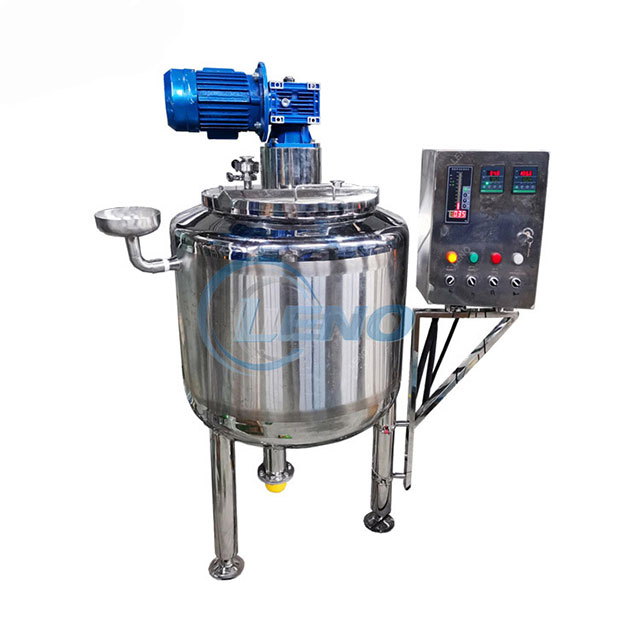
Certain processing parameters demand strict thermal intervention. Relying on ambient conditions will ruin these specific batches. A dual-wall system guarantees product viability under rigorous manufacturing conditions.
Specific physical reactions act as immediate triggers for jacketed vessels. Phase changes represent a primary trigger. Melting solid waxes or butters requires sustained, controlled heat. Pasteurization protocols demand rapid heating followed by immediate chilling. Crystallization processes need precisely descending temperature curves. Strict temperature-dependent chemical reactions stall if the batch runs too cold. They degrade if the batch runs too hot.
Mechanical action generates intense thermal energy. Integrating an emulsifying homogenizer tank introduces massive friction into the batch. A high-shear rotor-stator head spins at thousands of revolutions per minute. This physical tearing of molecules rapidly heats the surrounding liquid. A cooling jacket becomes critical here. It counters the mechanical heat load. Without active cooling, friction will easily scorch heat-sensitive ingredients. It breaks delicate emulsions.
Not all jacketed systems operate the same way. You must select the heating source based on your facility infrastructure.
An electric heating mixing tank relies on internal immersion elements. The elements heat a stationary or slowly circulating thermal fluid inside the jacket. This setup suits facilities lacking centralized boiler infrastructure. You benefit from an easier plug-and-play installation. Heat-up times generally run slower than alternative methods. We recommend this configuration for smaller batches. It works well for applications requiring moderate maximum temperatures.
A steam heating tank connects directly to an existing facility boiler. Steam provides massive latent heat energy upon condensation. It offers rapid, high-capacity thermal transfer. This approach dominates high-volume production environments. It handles rapid thermal cycling effortlessly. However, it demands strict pressure-vessel compliance. Maintenance teams must rigorously manage steam traps, pressure regulators, and condensate return lines.
Equipment choices stretch far beyond the initial installation day. You must evaluate how vessel architecture impacts your overall production volume over time. System selection directly influences facility output and long-term utility management.
A single layer tank features a very straightforward setup. It requires minimal utility hookups. However, a jacketed tank dramatically reduces batch cycle times for temperature-dependent formulations. You can heat up and cool down much faster. This active regulation increases overall daily throughput. Faster turnover allows operators to run more shifts per day. High yield offsets the complex installation requirements of a dual-wall system.
You must evaluate your facility utility capabilities honestly. Jacketed tanks place heavy demands on infrastructure. Steam systems require robust boiler capacity. Electric heating models demand high-amperage, three-phase electrical circuits. Cooling cycles depend heavily on industrial chillers or cooling towers. You cannot simply drop a heated vessel into a plant without auditing these utility loads. An underpowered chiller will cripple your cooling times.
Scaling a thermal process introduces serious engineering friction. A recipe developed in a 50-liter pilot jacketed tank behaves differently in a 2000-liter production vessel. The surface-area-to-volume ratio decreases drastically as tanks grow larger. This means thermal transfer times increase significantly. You must calculate slower heating and cooling ramps into your production schedules. Engineers often combat this by adding half-pipe coil jackets or internal heat-transfer baffles to large tanks.
Operating pressurized, heated vessels introduces distinct workplace hazards. Industrial regulations exist to mitigate these risks. You must navigate certification codes and safety protocols carefully before commissioning.
Safety authorities heavily regulate enclosed thermal systems. Jacketed tanks utilizing steam or high-pressure thermal fluids usually require specific engineering certifications. In North America, this generally means ASME Boiler and Pressure Vessel Code compliance. Similar strict directives exist globally (like PED in Europe). Operating an uncertified pressure vessel violates industrial safety laws. It invites catastrophic equipment failure. Always verify jacket pressure ratings with the manufacturer.
Thermal regulation creates extreme exterior temperatures. Running steam through a bare stainless steel jacket turns the outer wall into a severe burn hazard. You must specify external cladding or insulation over the jacket. Insulation protects operators from accidental contact. It also prevents ambient heat loss. A fully insulated tank directs all thermal energy into your product. This maximizes utility efficiency and stabilizes the surrounding room temperature.
Thermal cycling stresses the vessel structure over time. Metal expands during heating and contracts during cooling. This continuous stress requires strict maintenance oversight. Clean-In-Place (CIP) and Sterilize-In-Place (SIP) routines push these temperature swings to the extreme. You must verify jacket integrity regularly. Implement routine leak testing during maintenance windows. A compromised inner weld will leak toxic thermal fluid directly into your product batch.
Your process chemistry and thermal requirements must ultimately dictate vessel selection. Do not compromise fluid stability for simpler installation. Single layer tanks serve perfectly for ambient, non-reactive storage and simple blending. However, the moment your formulation demands phase changes, strict pasteurization, or heavy mechanical shear, dual-wall thermal regulation becomes mandatory.
Before finalizing your equipment specifications, take three critical action steps. First, map out the precise temperature curves your product requires. Second, audit your facility infrastructure to ensure you have the steam, chilled water, or electrical capacity to support thermal loads. Finally, anticipate the friction generated by high-shear mixing heads. Aligning these factors ensures your mixing equipment delivers consistent, high-yield batches without overwhelming your facility infrastructure.
A: Retrofitting is highly inefficient. Operators sometimes strap external band heaters to a single layer tank. This approach provides uneven heating and poses a major safety risk for operators. It lacks proper insulation, wasting massive amounts of energy. For safe, uniform heat distribution, you need a true dual-wall jacketed solution designed for thermal fluid expansion.
A: A conventional jacket provides an open annular space, suitable for low-pressure heating. A dimple jacket features spot-welded indentations across the surface. These dimples create high fluid turbulence, which increases heat transfer rates. Dimple designs allow the use of thinner stainless steel while maintaining high pressure ratings, making them ideal for steam applications.
A: It depends on the design. Steam and chilled water setups require hard-piped, continuous utility connections to facility boilers or chillers. However, self-contained electric heating models utilize a sealed jacket filled with thermal oil. They only require a heavy-duty electrical connection to heat the internal fluid, eliminating the need for continuous external fluid piping.
A: Emulsifying requires a rotor-stator mixing head running at extremely high speeds. This aggressive shearing action generates substantial mechanical friction. The friction quickly converts into heat, rapidly raising the batch temperature. A cooling jacket counters this phenomenon. It constantly removes the mechanical heat, preventing delicate, heat-sensitive ingredients from burning or separating.


