Language

Views: 0 Author: Site Editor Publish Time: 2026-06-29 Origin: Site


Scaling sauce and jam production introduces critical risks. You face batch inconsistency, localized scorching, and workflow bottlenecks daily. Moving from direct-heat cooking to indirect heating requires a precise equipment match. Old methods simply fail under commercial demands. Selecting the right vessel demands careful consideration. You must evaluate facility constraints, product viscosity, and long-term compliance rather than just upfront equipment availability.
Choosing an industrial vessel dictates your entire production rhythm. It impacts how fast you can cook. It determines how easily your team cleans up. It also safeguards your product's flavor profile. If you choose poorly, you risk ruined batches and frustrated operators. In this comprehensive guide, you will discover how to match your recipe's physical traits to the perfect machinery. We will explore heat sources, discharge methods, and agitation styles. You will learn to eliminate burn-on risks and optimize your commercial kitchen for maximum yield.
Heat Source Dictates Infrastructure: Steam jacket kettles offer the fastest recovery times but require external boiler systems; electric/thermal oil models are easier to install but have slower heat-up curves.
Agitation is Non-Negotiable for Jams: High-sugar, viscous products require specialized PTFE/Teflon surface-scraping agitators to prevent burn-on and ensure uniform heat distribution.
Discharge Method Impacts Yield: A tilting jacket kettle is essential for thick jams with particulates, while stationary bottom-valve kettles suit high-volume, lower-viscosity sauces.
Compliance Mitigates Risk: Verifying ASME (or regional equivalent) pressure vessel certification is a strict prerequisite for commercial operation and insurance liability.
High Brix levels in jams make them incredibly volatile during cooking. The sugar content thickens rapidly. Thick emulsions in sauces also present similar challenges. Both are highly susceptible to scorching under direct heat. A traditional pot over an open flame creates severe hot spots. The bottom layer of your product absorbs too much energy. Once sugar burns on the bottom, the bitter flavor permeates the entire batch. You lose the product, and cleaning the scorched pot halts your production schedule.
Integrating a jacket kettle provides the ultimate solution. This equipment utilizes a hemispherical double-wall design. Heat transfers uniformly across the entire wetted surface area. Instead of a single hot spot at the base, thermal energy wraps around the sides. The gentle, consistent heat prevents sugars from caramelizing too quickly on the metal.
To measure the success of your new equipment deployment, you must look at three specific criteria:
Reduced Batch Time: Uniform heating brings large volumes to a boil faster than direct flame.
Zero Scorching Loss: Indirect heating eliminates burnt product stuck to the vessel walls.
Standardized Turnaround: Smooth hemispherical interiors speed up CIP (Clean-in-Place) or manual sanitation turnaround times.
Common Mistake: Operators often test equipment using water. Water has vastly different flow characteristics than fruit preserves. Always evaluate equipment capabilities using your actual viscous recipe.
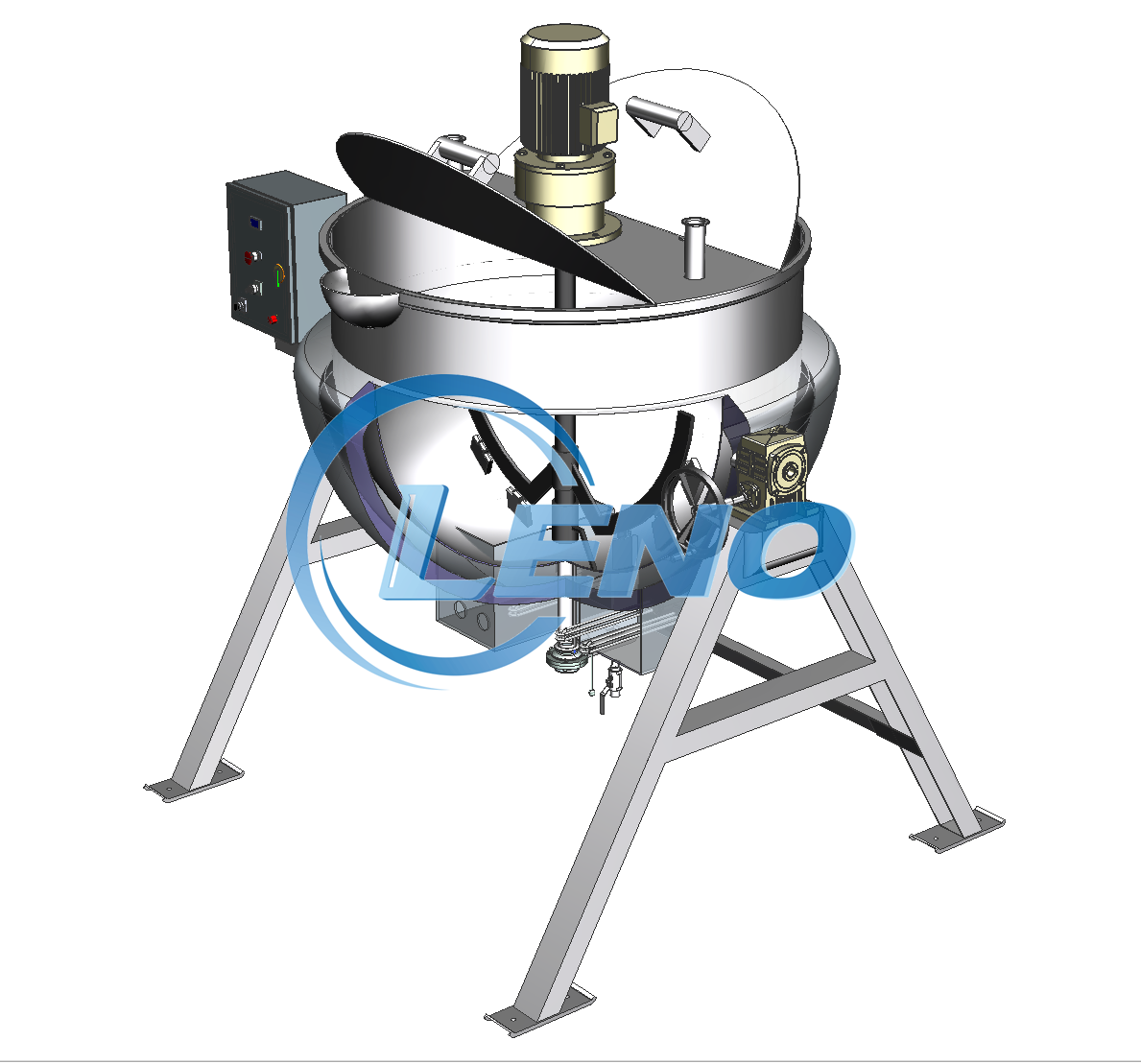
Your facility infrastructure heavily influences your equipment choice. The heat source dictates how quickly you can process batches. It also determines your installation requirements.
Facilities often rely on a steam jacket kettle for high-volume processing. Direct steam enters the jacket under high pressure.
Pros: Steam offers the fastest heat-up and recovery times available. You gain almost immediate temperature control. Furthermore, if plumbed for chilled water, you can rapidly cool your product right in the vessel.
Cons/Risks: You must have an existing facility steam boiler system. It requires dedicated piping, pressure-reducing valves, and specialized maintenance protocols.
Electric models use internal heating elements to warm a heat-transfer fluid within the jacket.
Pros: These units are entirely self-contained. They present a much lower installation barrier. They are excellent for scaling cottage food businesses lacking steam infrastructure.
Cons/Risks: They possess slower heat-up curves. The thermal oil requires periodic replacement. You must monitor the fluid carefully to prevent chemical degradation over time.
Gas models burn natural gas or propane directly under a sealed jacket.
Pros: Gas provides a very high energy output. It proves highly useful where high-voltage electrical panels or external steam boilers remain unavailable.
Cons/Risks: You face strict exhaust ventilation requirements. Gas combustion also creates significantly higher ambient heat in your production room.
Heat Source | Heat-Up Speed | Infrastructure Required | Best Application Scenario |
|---|---|---|---|
Direct Steam | Extremely Fast | External boiler, steam pipes, traps | Large commercial plants, rapid cooling needs |
Electric (Thermal Oil) | Moderate / Slow | High-voltage electrical panel | Mid-sized facilities, standalone kitchens |
Gas-Fired | Fast | Gas lines, heavy exhaust hoods | Locations lacking strong electrical grids |
Getting your finished product out of the vessel safely is just as important as cooking it. Product viscosity dictates your ideal discharge mechanism.
A tilting jacket kettle hinges on a specialized trunnion. Operators pour the contents directly into receiving bins or transfer pumps. This design is best for chunky jams, thick gravies, and highly viscous fruit preserves. Standard bottom valves simply clog when handling large fruit pieces or heavy starches.
When evaluating tilting models, you must look for motorized tilt mechanisms on any unit over 50 gallons. Manual hand-cranks on massive vessels pose severe ergonomic risks to your workers. Motorized controls protect worker ergonomics while ensuring 100% product yield without clogging valves.
Stationary designs remain fixed in place. They utilize a valve at the lowest point of the hemisphere. This style is best for broths, hot sauces, and smooth, pumpable liquids. Gravity naturally feeds the liquid into your packaging line.
When evaluating stationary models, you must demand flush-mounted, sanitary valves. The tangent draw-off style is the industry standard. A poorly designed valve creates an unheated "dead leg." A dead leg is a section of pipe protruding outside the heated jacket. Product resting in this unheated section drops in temperature. Bacteria harbor easily in these cool zones. Furthermore, the product trapped there remains undercooked, compromising your entire batch safety.
Heat application alone cannot guarantee product quality. You must move the product continuously across the heated surface. The right sauce cooking kettle relies on specialized agitation mechanics.
Standard marine propellers or simple paddles fail when processing thick preserves. High-sugar jams adhere stubbornly to the kettle walls. A dedicated commercial unit must feature surface scrapers. These scrapers attach to the main agitator arm. They press directly against the metal hemisphere. Look for spring-loaded or inclined surface scrapers made from food-grade PTFE or Teflon. They constantly wipe the heated surface. This action pushes heated product into the center and pulls cooler product to the edges.
Different recipes require vastly different mixing forces.
High-Shear Applications: Emulsified sauces like mayonnaise, salad dressings, or hollandaise require intense mechanical force. You often need a secondary high-shear homogenizing head installed alongside the main scraper. This breaks down oil and water molecules, forcing them to bind securely.
Low-Shear Applications: Fruit jams, chunky salsas, and delicate stews require low-shear mixing. You need gentle folding action. Aggressive blending destroys fruit integrity, turning premium chunky preserves into an undesirable puree.
You cannot operate a scraper at a single fixed speed. Variable Speed Drives (VFD) are essential for commercial operations. You need fast agitation while bringing raw juices to a boil. However, as the reduction process thickens your product, you must reduce the RPMs. The VFD allows operators to adjust speeds on the fly. This prevents massive electrical loads on the motor as viscosity peaks.
Buying the right machinery means little if your facility cannot support it. Implementation requires careful mathematical planning and strict adherence to safety codes.
Never fill a kettle to the brim. The total volume listed on a specification sheet does not equal your usable space. A 100-gallon unit typically yields only 75-80 gallons of working capacity. You must account for rolling boils. You also need headspace for agitation displacement. If you fill a vessel completely, the scraper will push hot, sticky jam over the sides. Always size up your equipment based on your required working capacity.
The jacket surrounding your product operates under extreme pressure. As steam or thermal oil heats up, it expands violently. Uncertified, imported kettles pose severe explosion risks. North American facilities must look for the ASME (American Society of Mechanical Engineers) certification stamp. European facilities require CE marks. Operating an uncertified pressure vessel violates local safety codes. It will fail local safety inspections immediately. Furthermore, operating uncertified pressurized equipment will entirely void your facility insurance policies.
Floor space represents only one physical constraint. You must consider the entire three-dimensional footprint.
Ceiling Height: You need adequate vertical clearance to lift the heavy agitator arm out of the hemisphere for deep cleaning.
Floor Drain Placement: Washdown procedures generate massive amounts of wastewater. Ensure trench drains sit directly beneath the discharge valves.
Floor Load-Bearing Capacity: A 200-gallon vessel filled with dense fruit preserves weighs thousands of pounds. Verify your concrete slab can handle the concentrated point loads at the equipment legs.
Scaling your production demands a careful balance of facility infrastructure and product characteristics. The optimal vessel aligns your available utilities with the specific flow traits of your recipes. Understanding the nuances of heat distribution, discharge methods, and agitation ensures your commercial transition succeeds.
Take these actionable steps before proceeding:
Audit your facility's utility capabilities today. Confirm exact voltage limits and existing steam boiler capacities.
Calculate your required daily throughput based on working capacity, not total vessel volume.
Identify your product's specific shear requirements to choose the correct scraper configuration.
Verify all ceiling heights and floor drain locations in your production room.
A: Steam uses pressurized water vapor from an external boiler for rapid heating and cooling. It offers immediate temperature control. Thermal oil uses built-in electric elements to heat a reservoir of heat-transfer fluid. It offers steady heat without requiring external boiler infrastructure, but it heats up more slowly.
A: Generally, no. Thin, pumpable liquids like hot sauce are efficiently discharged via a stationary kettle. You simply use a sanitary bottom valve. This stationary setup integrates easily with liquid filling machines and transfer pumps.
A: It varies by heat source and capacity. Steam heating is nearly instantaneous, bringing products to a boil rapidly. Electric thermal oil units can take 45–90 minutes to reach operating temperatures for large batches.
A: Yes, but electrical limitations usually restrict small businesses to 10-20 gallon electric tabletop models. Standard residential wiring rarely supports the 3-phase power required for larger industrial kettles.


