Language

Views: 0 Author: Site Editor Publish Time: 2026-07-19 Origin: Site


Selecting the wrong filter vessel disrupts entire production lines. Fluid bypass ruins product batches. Excessive downtime during bag changeouts eats into operational margins. Pressure blowouts from undersized units even pose serious safety hazards to facility personnel. We must move beyond generic catalog specifications to ensure reliable operation.
You need to match housing design directly to specific fluid properties and facility limits. A mismatch causes premature blinding and rapid pressure drops. You must evaluate construction materials, physical sizing, and closure types meticulously. A reliable procurement decision requires aligning flow rates, chemical compatibility, and compliance standards first. In this guide, we explore how to evaluate these critical factors before you review vendor quotes. You will learn to navigate sizing charts, evaluate structural integrity, and select the right advanced configurations.
Sizing hinges on viscosity, not just flow rate: Standard flow charts use water; high-viscosity fluids demand significantly larger housing surface areas to prevent rapid pressure drops.
Configuration dictates uptime: Continuous processes require a duplex bag filter, while temperature-sensitive fluids necessitate a jacketed bag filter.
Sealing mechanisms prevent bypass: The internal basket design and lid closure type (e.g., clamp vs. swing bolt) dictate the true efficiency of the liquid filtration housing.
Compliance limits material choices: Corrosive fluids, food-grade applications, and high-pressure lines legally restrict housing materials and require specific certifications (e.g., ASME, FDA).
You cannot select an industrial bag filter housing based purely on pipe size. Accurate process mapping establishes the foundation for any successful filtration setup. Facility engineers must quantify four essential operational parameters.
Flow Rate (GPM/LPM) & Pressure: Establish both standard operating pressure and maximum design pressure. Peak flow rates during system surges always dictate housing capacity. You must size the vessel to handle these periodic spikes. Ignoring surge conditions causes premature bag rupture.
Fluid Viscosity & Temperature: Viscosity fundamentally alters the dynamic pressure drop. Engineers measure this in Centipoise (cps). Higher viscosities exponentially reduce the effective flow capacity of standard vessels. Pumping thick syrups requires drastically more surface area than pumping municipal water.
Particulate Loading & Type: Assess whether the suspended solids are deformable gels or rigid particles. Deformable gels extrude through media under high pressure. High solid loading often necessitates multi-bag configurations rather than a single unit. This choice maintains acceptable maintenance intervals.
Chemical Compatibility: Identify fluid pH and chemical aggressiveness. Process chemicals narrow down housing material options early in the evaluation. Strong acids dissolve standard steel rapidly. Highly alkaline solutions demand specific gasket materials to prevent leaks.
Always install upstream and downstream pressure gauges. They provide real-time differential pressure readings. Measure fluid viscosity at the exact operating temperature. Cold startup conditions often present the highest viscosity levels. Use these worst-case metrics for your baseline calculations.
Engineers categorize filter vessels using standardized industry sizing. These numbers dictate the internal basket dimensions. They also determine the surface area available for capturing contaminants. Understanding these categories prevents catastrophic undersizing.
Standardized sizes ensure you can easily source replacement filter bags globally. The physical dimensions dictate flow limits and dirt-holding capacity.
Size #1: Measures approximately 7" x 16". Best suited for moderate flow applications requiring smaller footprints.
Size #2: Measures approximately 7" x 32". This is the standard industrial workhorse. It serves best for high-capacity baseline mapping.
Size #3: Measures approximately 4" x 8". Used strictly for very low-flow laboratory environments.
Size #4: Measures approximately 4" x 14". This compact option proves ideal for point-of-use or low-flow batch processes.
Housing Size | Dimensions (Diameter x Length) | Approximate Surface Area | Max Water Flow Rate (GPM) |
|---|---|---|---|
Size #1 | 7" x 16" | 2.0 sq. ft. | 90 GPM |
Size #2 | 7" x 32" | 4.4 sq. ft. | 200 GPM |
Size #3 | 4" x 8" | 0.5 sq. ft. | 20 GPM |
Size #4 | 4" x 14" | 1.0 sq. ft. | 50 GPM |
An undersized housing causes rapid differential pressure (ΔP) increases. This forces premature bag replacement. You will spend excess hours replacing blinded media. High fluid velocity through inadequate surface area also pushes contaminants through the media pores. To avoid this, always aim for the lowest initial pressure drop possible.
Bulk flow rates exceeding 200 GPM demand a larger solution. You must scale up to a robust liquid filtration housing containing multiple bags. Multi-bag units accommodate anywhere from 2 to 24 separate filter bags inside one large shell. This design shares the flow volume equally. It maintains low fluid velocity and maximizes the dirt-holding capacity for heavy industrial operations.
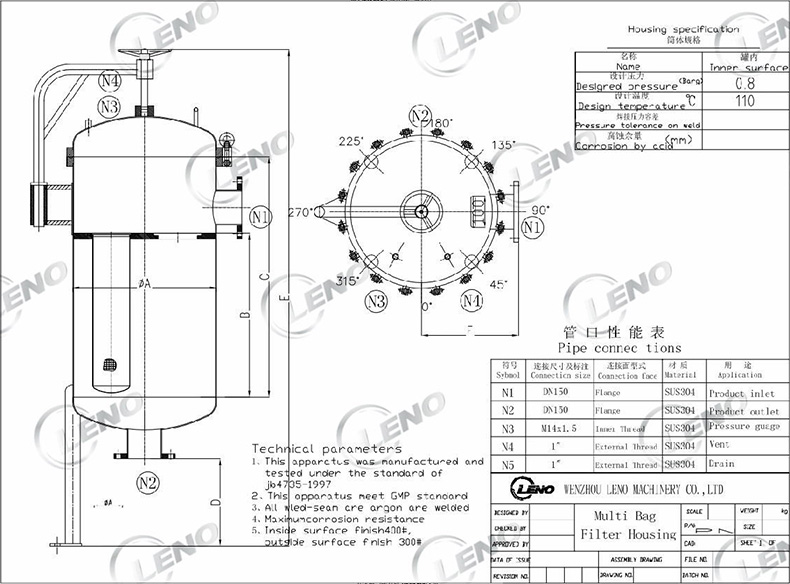
The structural material of your vessel determines its operational lifespan. You cannot compromise on metallurgy when handling aggressive chemicals or high-pressure fluids. Selecting the proper alloy prevents catastrophic failure, contamination, and costly facility shutdowns.
Stainless steel dominates the industrial filtration market. However, not all stainless grades offer the same chemical resistance.
304 Stainless Steel: This remains the standard for general industrial water and mild chemicals. It handles neutral pH fluids perfectly. It is highly cost-effective for basic municipal or cooling tower water.
316L Stainless Steel: This grade adds molybdenum for superior pitting resistance. It is strictly mandatory for high-chloride environments. Pharmaceutical applications and corrosive chemical processes demand 316L. The "L" denotes low carbon, which prevents corrosion around welding seams.
Carbon steel provides incredible structural strength at a lower price point. It remains cost-effective for non-corrosive hydrocarbons. Refineries use it heavily for oils and petrochemical applications. You should only specify carbon steel where rust is not a primary product contamination concern. Many manufacturers apply epoxy coatings internally to extend carbon steel lifespans.
Metals fail rapidly in ultra-corrosive environments containing strong acids or aggressive bleaches. Polypropylene and CPVC vessels provide the necessary alternative. They resist harsh chemical attacks effortlessly. However, plastic housings introduce stricter operational limitations. They cannot withstand high temperatures or extreme pressures. You must strictly monitor thermal limits to prevent plastic deformation.
Sanitary applications demand specific internal surface conditions. Standard mechanical polishing removes rough welding marks. Food-grade and pharmaceutical environments require electropolishing. Electropolishing strips away microscopic surface metal. It leaves a mirror-like finish. This smooth surface prevents bacterial growth and allows for thorough clean-in-place (CIP) procedures.
Standard single-vessel setups cannot satisfy every industrial process. Continuous operations and temperature-sensitive fluids require specialized engineering. Evaluating advanced configurations ensures your production line remains online and efficient.
Single housings require complete line shutdowns for filter changes. Stopping the pumps halts production entirely. A duplex bag filter solves this problem gracefully.
Duplex systems utilize two parallel housings connected by a diverter valve array. When one vessel fills with contaminants, operators simply turn the valve assembly. The fluid flow instantly redirects to the clean secondary housing. The operator then opens the offline vessel safely, replaces the bag, and prepares it for the next cycle. Production never stops.
Evaluate the valve actuation type carefully. Manual butterfly valves work well for accessible locations. Automated pneumatic valves suit remote or hazardous environments. Always verify valve seals remain chemically compatible with your specific process fluid.
Temperature control poses severe challenges for specific liquids. Resins, waxes, chocolates, and heavy oils often solidify at room temperature. They spike in viscosity and blind the filter media instantly. A jacketed bag filter eliminates this frustrating issue.
This configuration features a specialized double-wall construction around the outer shell. Facilities circulate steam, hot water, or thermal oil through this outer cavity. The heat transfers evenly inward, maintaining the fluid at optimal pumping viscosity. When evaluating these units, always verify the pressure rating of the heating jacket independently from the internal filtration chamber. They operate on separate pressure loops.
A filtration vessel only performs as well as its weakest seal. Bypass around the bag collar ruins downstream product. Furthermore, the physical closure mechanism heavily influences operator fatigue. You must balance mechanical security against maintenance efficiency.
Manufacturers design lids to handle different pressure ratings and frequency of access. You have three primary choices.
V-Band Clamps: These provide an economical solution. They suit low-pressure systems requiring infrequent changeouts. Operators simply loosen a single toggle to remove the lid. However, v-band clamps degrade quickly under harsh industrial abuse.
Swing Bolts / Eye Nuts: This design utilizes heavy-duty bolts swinging upward into slotted lid flanges. They act slower but prove structurally robust. Swing bolts are completely mandatory for higher process pressures. They distribute mechanical stress evenly across the lid perimeter.
Quick-Opening Closures (QOC) / Davit Arms: These command a high upfront cost. However, a hand-wheel or spring-assisted davit arm drastically reduces operator fatigue. They minimize downtime in high-frequency changeout environments. One operator can open a heavy multi-bag unit safely in seconds.
Dirty fluid naturally seeks the path of least resistance. You must evaluate the internal hold-down ring or compression mechanism. A housing is only as effective as its internal seal. If the bag collar does not seat perfectly against the internal ledge, dirty fluid bypasses the filter media entirely.
Standard snap-ring bags require heavy spring-loaded hold-down assemblies. Advanced plastic flange collars often feature built-in handles. These flanges compress directly against a machined ledge inside the basket. Inspect these sealing surfaces regularly for wear. Train operators to ensure the collar sits entirely flat before closing the lid.
You cannot ignore code compliance. Uncertified housings introduce unacceptable facility safety risks in high-pressure gas or liquid systems. A pressurized vessel explosion causes catastrophic facility damage.
Verify necessary code stamping before purchase. Facilities in North America often require ASME Section VIII certification for pressure vessels. European installations demand CE/PED compliance. Sanitary dairy and food applications require strict 3-A sanitary standard certifications. Regulatory bodies fine facilities heavily for utilizing uncertified pressure vessels.
Proper filtration protects downstream equipment and ensures final product quality. Base your initial vendor shortlisting heavily on material compatibility and required code compliance. Next, filter the remaining options by evaluating closure types and acceptable lead times. A cheap vessel constructed from incompatible metal ultimately fails and shuts down production.
Action-oriented next steps for buyers:
Request detailed general arrangement (GA) drawings from the vendor to confirm facility footprint compatibility.
Demand precise differential pressure drop curves calculated specifically for your fluid's operating viscosity.
Confirm the exact type of internal hold-down mechanism utilized.
Train facility operators on proper seating techniques for new filter collars.
A: Standard commercial units typically operate safely between 100 and 150 PSI. For heavier industrial processes, manufacturers engineer ASME-coded high-pressure units capable of withstanding 300+ PSI. Always check the manufacturer's nameplate before pressurizing.
A: You monitor the differential pressure gauges installed upstream and downstream. Operators typically schedule a bag changeout when the differential pressure (ΔP) reaches 15 to 20 PSI. Pushing past this limit risks catastrophic media rupture and severe fluid bypass.
A: Standard units utilize nominal-rated bags. Even with absolute-rated micro-fiber bags, internal bypass risks exist around the collar seal. Bag housings prove less ideal for strict absolute filtration compared to tightly sealed cartridge housings.
A: No. While the external dimensions match, the collar types vary significantly. You must match the specific collar type—such as a steel snap-ring or a specific plastic molded flange—to the exact internal seating ledge designed by the housing manufacturer.


