Language

Views: 0 Author: Site Editor Publish Time: 2026-06-24 Origin: Site


High-viscosity processing introduces steep daily challenges on the production floor. Facility operators constantly battle inconsistent emulsions. They face frustratingly long batch times. They frequently encounter scaling failures when moving recipes from the lab to full production. Legacy agitation methods often rely on simple low-speed impellers. These older setups just push fluids around the vessel. They struggle to break down stubborn agglomerates or force immiscible liquids to blend. Upgrading your line changes this dynamic entirely. Modern high shear mixing introduces exact mechanical precision to your workflow. Intense hydraulic forces replace slow churning. This article provides an evidence-based evaluation of high shear technology. We examine its direct impact on product quality and operational returns in the cosmetics and food sectors. You will learn how to match equipment to specific viscosity profiles. We also uncover common scale-up variables you must anticipate to succeed.
High shear mixers drastically reduce batch times by utilizing a rotor-stator mechanism to eliminate agglomerates and stabilize emulsions.
In cosmetics, they ensure uniform dispersion of active ingredients and stable shelf-life; in food processing, they dictate texture, mouthfeel, and compliance with sanitary standards.
Capitalizing on this technology requires matching the mixer type (batch vs. in-line) to the specific viscosity profile and shear rate demands of the product.
Successful implementation demands anticipating scale-up variables, particularly localized heat generation and cleaning-in-place (CIP) compatibility.
Traditional low-speed impellers fail at creating stable emulsions. They lack sufficient energy. Cohesive powders clump into unyielding masses under low agitation. Immiscible liquids like oil and water separate rapidly. Basic stirrers simply move the problem around the tank. The fluid often rotates as a solid body. It lacks the necessary velocity gradient to shear particles apart. You cannot force a tight emulsion simply by stirring longer.
The solution lies in specialized rotor-stator fluid dynamics. A high-speed rotor spins closely inside a stationary stator. This arrangement defines the working principle of advanced mixing. The spinning rotor draws fluid into the center of the mixing head. Centrifugal force pushes the material outward through the stator's machined openings. This narrow gap generates intense hydraulic and mechanical shear forces. Agglomerates tear apart instantly. Droplets shatter into exceptionally fine dispersions.
This mechanical action drives serious business outcomes. Faster mixing drastically cuts production hours. Facilities typically see a 50% to 80% reduction in mixing times. Shorter cycles mean lower energy consumption per batch. Better dispersion minimizes raw material waste. When replacing traditional stirrers, a robust high shear mixer pays for itself quickly through these direct operational efficiencies.
Cosmetic formulators focus heavily on emulsion stability. Consumers expect uniform texture in lotions, creams, and gels. They reject gritty or separated products immediately. A modern cosmetic mixing tank requires serious shearing power. Pairing it with a high-performance emulsifying mixer prevents dreaded phase separation. This dynamic maintains product integrity over its entire shelf life.
Hydrating rheology modifiers presents a notorious challenge. Ingredients like Carbopol or xanthan gum resist simple mixing. Poor agitation creates "fish-eyes". These are clumps of dry powder trapped inside a gelized outer layer. High shear forces shatter these lumps instantly. The mechanical action forces water into the powder matrix. It guarantees a smooth, fully hydrated gel without filtering.
Food engineers prioritize droplet size reduction. Small droplets ensure consistent mouthfeel. They also prevent syneresis over time. Syneresis happens when water weeps or bleeds out of a mixture. Consider the exacting standards required for dressing emulsions. Using a specialized mayonnaise mixer serves as a perfect example. It achieves incredibly tight oil-in-water emulsions. This tightness creates a rich, creamy texture.
Sanitary compliance dictates equipment design in this sector. Food production strictly follows FDA, EHEDG, or 3-A Sanitary Standards. Hygienic manufacturing tolerates zero compromise. Good high shear designs eliminate dead zones inside the mixing chamber. They prevent bacterial growth. Smooth finishes and crevice-free stators ensure full hygienic compliance during every shift.
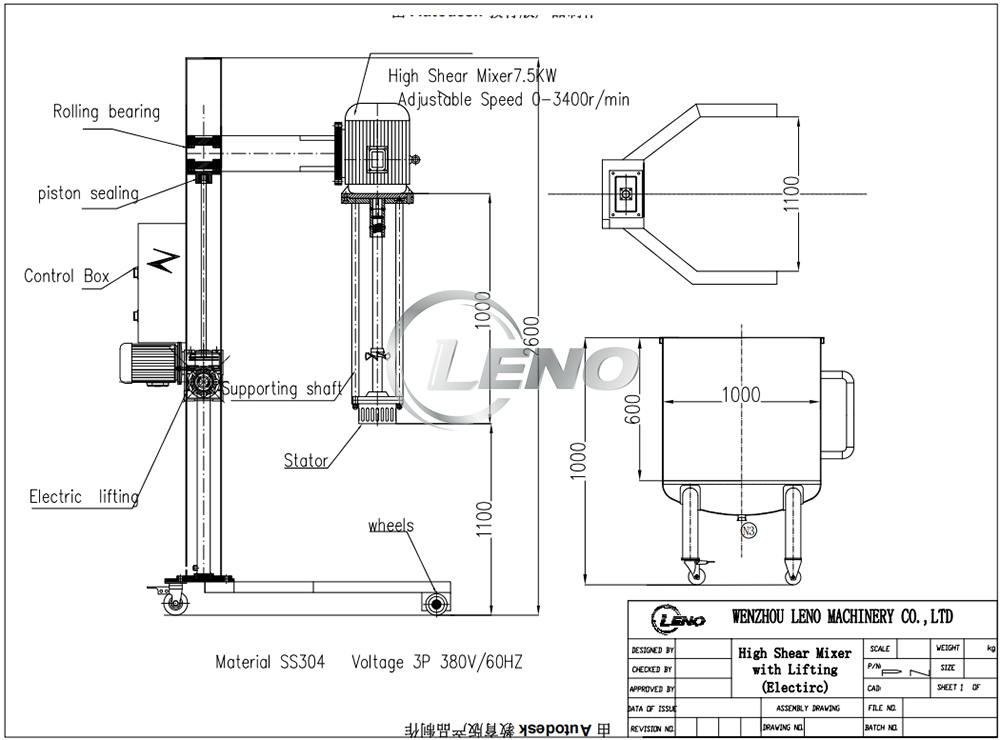
High shear mixers handle primary emulsification brilliantly. They reduce particles down to roughly 2 to 5 microns. High-pressure homogenizers tackle sub-micron processing. These two machines serve different purposes. A common decision rule exists in process engineering. Use high shear first. It relieves the intense mechanical load on downstream homogenizers. This sequential approach prevents homogenizer clogs and extends valve life.
Facilities must also choose between batch and in-line configurations. Batch mixers suit smaller, flexible production runs. You drop the mixer directly into the vessel. However, batch processing risks localized over-processing. The fluid near the mixing head receives more shear than fluid at the tank edge. In-line mixers offer a different approach. They provide continuous processing outside the main tank. Fluid passes through the rotor-stator once. This guarantees a single-pass shear history. It makes recipe scale-up highly predictable.
Technology Comparison Chart: Mixers vs. Homogenizers | |||
Technology Type | Primary Function | Target Particle Size | Optimal Application |
|---|---|---|---|
Batch High Shear | Rapid dispersion & hydration | 2 – 10 microns | Flexible cosmetic runs, gum hydration |
In-Line High Shear | Continuous emulsification | 2 – 5 microns | High-volume sauces, single-pass processing |
High-Pressure Homogenizer | Extreme cell rupture | 0.1 – 1 micron | Pharmaceuticals, specialized nano-emulsions |
Evaluating equipment requires strict attention to physical limitations. Viscosity thresholds dictate performance. High shear mixers lose efficiency above certain limits. The exact limit depends on the stator design. Highly viscous materials need mechanical help. You must add anchor agitators or positive displacement pumps. These tools feed thick material directly into the mixing head.
Typical Viscosity Limits for High Shear Configurations | |
Equipment Setup | Maximum Flow Efficiency (cps) |
|---|---|
Standard Batch Mixer (Standalone) | Up to 10,000 cps |
In-Line Mixer (Self-Pumping) | Up to 20,000 cps |
Mixer + Co-Axial Anchor Agitator | Up to 50,000 cps |
Mixer + Positive Displacement Pump | 100,000+ cps |
You must calculate the required turnover rate to avoid unmixed zones. A high flow rate prevents stagnation at the vessel edges. Divide your total batch volume by the mixer's flow rate. This determines how long one full turnover takes. Most stable emulsions require 10 to 20 turnovers. This calculation directly influences the size of the motor you purchase.
Follow this checklist when evaluating sanitary and compliance features:
Verify CIP/SIP capabilities: Ensure the equipment supports clean-in-place and sterilize-in-place protocols without manual teardowns.
Select appropriate mechanical seals: Choose single seals for standard fluids. Upgrade to double flushed seals for sticky or abrasive slurries.
Inspect material finishes: Demand 316L stainless steel for all wetted parts. Request electropolishing to minimize bacterial harbor points.
Check self-draining angles: Confirm the housing drains completely by gravity to prevent cross-contamination.
Balance the higher initial capital expenditure (Capex) against your operational savings (Opex). Advanced mixers cost more upfront. However, these initial costs offset rapidly. You save significant money through reduced batch times. You consume less electricity per kilogram processed. You also experience significantly lower scrap rates because of superior dispersion.
Intense mechanical shear generates significant heat. High energy dissipation directly warms the fluid. You must acknowledge the heat generation trade-off. Formulators often process sensitive food or cosmetic ingredients. These components degrade under thermal stress. You must utilize cooling jackets or temperature-controlled mixing vessels. This infrastructure absorbs the excess heat and protects your active ingredients.
Do not assume lab-scale RPMs translate directly to the production floor. Scale-up non-linearity traps many engineers. A 10,000 RPM lab mixer does not mean you need a 10,000 RPM production unit. Focus strictly on tip speed and shear rate. These serve as the true scaling metrics. The peripheral velocity of the rotor must remain constant as you size up the machine.
Abrasive suspensions wear down stators rapidly. You must set realistic expectations regarding wear and maintenance. Anticipate part replacements. Schedule routine inspections for your mechanical seals.
Monitor seal fluids: Check barrier fluid levels daily on double mechanical seals.
Inspect stator gaps: Measure the rotor-stator gap monthly to ensure wear has not reduced shear efficiency.
Log temperature spikes: Unexplained heat increases often indicate failing bearings or excessive mechanical friction.
Stock critical spares: Keep extra stators and seal kits on hand to prevent extended downtime.
A high shear mixer provides immense value, but it is not a universal fix. It acts as a precision tool for specific emulsification and dispersion bottlenecks. Upgrading from simple agitators eliminates fish-eyes, reduces batch times, and guarantees shelf-stability for sensitive emulsions.
Define your production parameters before approaching vendors. Document your maximum product viscosity. Establish your target particle size. Outline your specific sanitary cleaning requirements. These hard metrics simplify the shortlisting logic and protect your investment.
Always demand proof of concept. Request empirical lab trials using your actual raw materials. Validate the specific shear requirements before committing to commercial sizing. Testing eliminates scale-up surprises and ensures your new equipment performs exactly as expected.
A: Standard agitators move fluid in bulk patterns. They rely on low speeds and open impellers. An emulsifying mixer uses a precise rotor-stator gap. It operates at high speeds. This narrow gap generates the extreme hydraulic shear rates necessary to shatter droplets and stabilize complex emulsions.
A: Yes, but rarely alone. Standard mixing heads lose flow efficiency beyond 50,000 cps. You must pair the mixer with co-axial systems or scraper blades. These auxiliary tools physically push thick, non-Newtonian pastes back into the active shear zone.
A: You utilize automated clean-in-place (CIP) protocols. Cleaning fluids flush through the equipment at high velocities. You must choose self-draining designs without internal dead zones. This prevents bacterial harbor points and ensures strict hygienic compliance between food batches.
A: It depends heavily on your production volume. Batch mixers excel at flexible, smaller runs with frequent recipe changes. In-line mixers work best for continuous, large-scale production. They guarantee a uniform shear history and eliminate the risk of over-processing sensitive cosmetic ingredients.


