Language

Views: 0 Author: Site Editor Publish Time: 2026-06-16 Origin: Site


High-viscosity mixing presents severe engineering risks for process manufacturers. Standard agitation often creates large dead zones where material sits undisturbed. These improper setups easily burn out expensive motors or completely degrade shear-sensitive products. Operators frequently face inconsistent batches, extensive downtime, and damaged equipment when using standard impellers on thick pastes or gels.
Sourcing the right equipment means looking beyond basic volumes. You must accurately align your product's rheological data—specifically dynamic viscosity and flow behavior—to exact mechanical capabilities. Heavy syrups, lotions, and polymers actively resist natural movement. They demand specific torque profiles, specialized agitator blades, and customized flow patterns to achieve true homogeneity.
This guide offers a comprehensive framework to properly evaluate equipment specifications. You will learn how to avoid common over-engineering traps while securing reliable operation. We will show you exactly how to match mechanical configurations to your desired process outcomes, ensuring efficient blending without thermal or physical product degradation.
Agitation is Process-Specific: High-viscosity products require specialized flow patterns; a standard propeller will not suffice.
Thermal Management: Incorporating heating capabilities drastically reduces product viscosity, lowering motor strain and batch times.
Material Selection: Standard 304 SS is cost-effective for industrial use, but 316L is non-negotiable for highly corrosive or strict sanitary environments.
Torque Over Speed: Viscous blending requires low-speed, high-torque gearboxes to prevent motor failure.
Designing an effective high viscosity mixing tank starts with understanding the physical behavior of your product. You cannot rely on guesswork. Engineers require exact data points to size the mechanical components correctly.
You must outline specific metrics before looking at equipment specifications. Dynamic viscosity, measured in Centipoise (cP), dictates the core design. For context, water sits at 1 cP. Honey measures around 10,000 cP, while heavy caulking compounds exceed 1,000,000 cP. Specific gravity (density relative to water) determines the overall mass the agitator must push. Batch size influences both the physical dimensions of the vessel and the required motor horsepower.
Viscous materials naturally resist flow. Pastes, gels, and heavy syrups do not behave like water. When an impeller turns in a thick fluid, it often creates a phenomenon called "caverning." The blade spins freely inside a small liquid cavity, while the bulk material nearest the tank walls remains completely stationary. These unmixed pockets ruin batch consistency. They also trap heat, leading to localized burning or uneven cooling.
Over-mixing poses a massive risk. Many thick products possess delicate molecular structures. Certain lotions, shampoos, and complex polymers lose viscosity permanently when exposed to high-shear forces. We call this behavior pseudoplastic or shear-thinning. If you spin an agitator too fast, you mechanically shear the polymer chains. The product thins out, completely ruining the formulation.
A successfully specified tank achieves homogeneous blending within your target batch time. It does so without causing product degradation or thermal damage. The final mixture must exhibit uniform temperature and uniform ingredient distribution. The equipment must operate smoothly without tripping electrical breakers or stalling the gearbox.
Agitator selection defines the success or failure of your entire mixing process. You cannot force a thick liquid to mix using the wrong blade shape.
Standard pitched-blade turbines or marine propellers fail miserably in thick materials. They rely on high rotational speeds to create turbulent flow. In viscous fluids, turbulent flow cannot exist. The propeller simply bores a hole down the center of the batch. The energy dissipates inches from the blade, leaving 90% of the tank volume completely stagnant.
Heavy-duty paddle agitators excel at pushing thick, non-Newtonian fluids. A properly designed paddle mixer tank uses wide, flat blades rotating at slow speeds. This broad surface area physically displaces massive volumes of material per revolution. Paddle agitators force the thick product to fold over itself. This macro-blending action works perfectly for medium-to-high viscosity applications where shear sensitivity remains a concern.
Anchor agitators represent the gold standard for sticky, baking-on materials. The anchor frame closely contours the interior dimensions of the vessel. Engineers often equip these anchors with Teflon (PTFE) scrapers. The scrapers physically drag along the metal walls. They constantly wipe the interior surface, preventing product build-up. This scraping action drastically improves heat transfer by constantly exposing fresh material to the heated tank wall.
Extreme viscosities or complex emulsions demand multi-shaft systems. These units combine two or three distinct mixing actions. A slow-speed anchor sweep constantly feeds material into a high-speed, high-shear homogenizer located in the center. The anchor handles the bulk flow, while the homogenizer breaks down agglomerates or creates tight emulsions. This dual-action approach prevents caverning while achieving intense microscopic blending.
Comparison of Agitator Types for Viscous Products | |||
Agitator Type | Optimal Viscosity Range (cP) | Primary Mixing Action | Best Application |
|---|---|---|---|
Standard Propeller | 1 - 3,000 | High-speed, localized flow | Water-like liquids, light oils |
Heavy-Duty Paddle | 3,000 - 50,000 | Low-speed, large volume displacement | Light pastes, syrups, sauces |
Anchor with Scrapers | 50,000 - 500,000 | Wall scraping, macro-folding | Sticky gels, cosmetics, peanut butter |
Multi-Shaft System | 100,000 - 1,000,000+ | Combined bulk flow and high shear | Thick emulsions, adhesives, silicones |
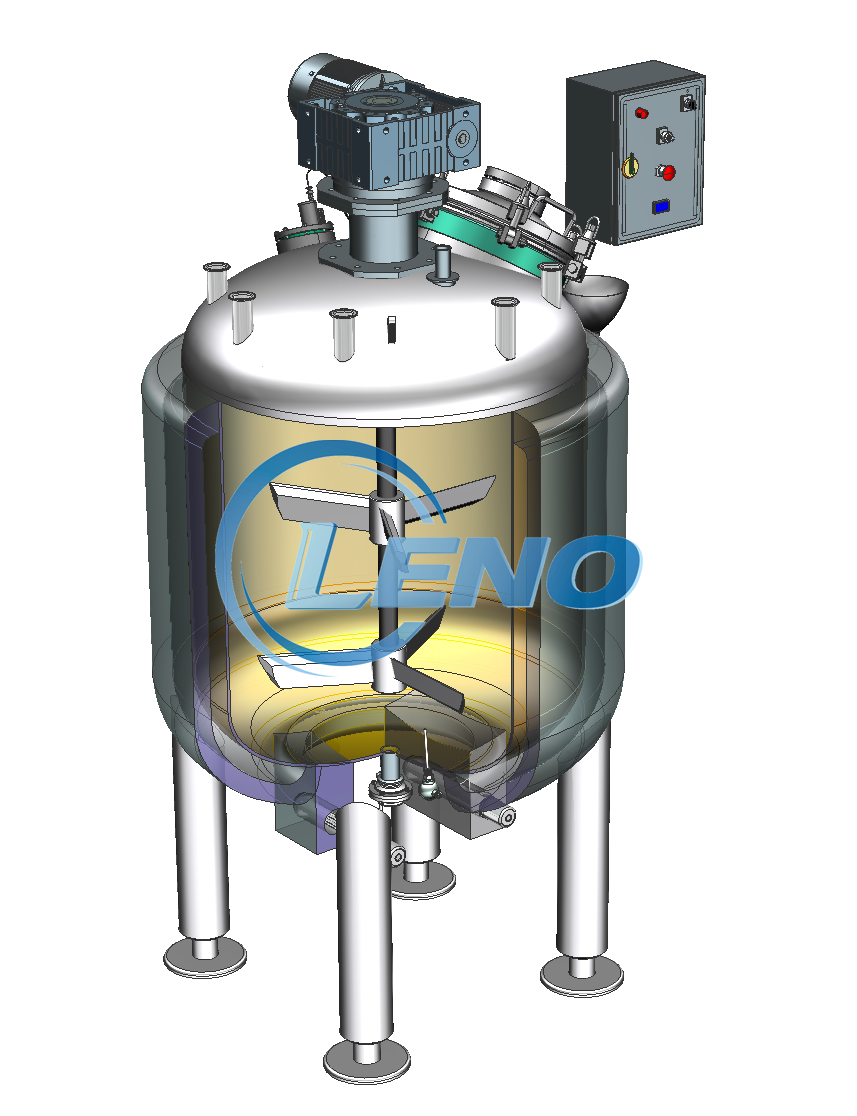
Viscosity is highly temperature-dependent. Controlling the temperature of your batch directly controls how easily it mixes.
Heating a product often lowers its dynamic viscosity significantly. A thick, stubborn wax might measure 100,000 cP at room temperature but drop to just 5,000 cP when heated to 150°F. This drastic reduction allows for much faster mixing. It lowers the mechanical resistance against the agitator blades, heavily reducing motor strain. Proper heating protocols shorten batch times and improve final homogeneity.
Specifying a jacketed mixing tank requires selecting the correct heat exchange mechanism based on your facility utilities.
Dimple Jackets: These are ideal for steam or hot/cold water utilities. The dimpled pattern creates turbulence in the heating fluid, offering excellent heat transfer rates. They allow for thinner inner vessel walls, making them highly efficient.
Half-Pipe Coil Jackets: Facilities utilizing high-pressure heating systems or specialized thermal fluids require half-pipe designs. Engineers weld split piping directly to the vessel exterior. This robust design easily handles severe pressure and thermal cycling.
Conventional (Double-Wall) Jackets: These involve a simple outer shell encompassing the inner vessel. They work well for low-pressure applications. However, they add significant weight and require thicker interior walls to handle internal pressures.
Heating a vessel exterior creates serious workplace hazards. You must emphasize the necessity of a fully insulated outer shell. Thick layers of mineral wool or polyurethane foam lock the heat inside the jacket. An outer stainless cladding layer protects the insulation. This design protects operators from severe burns, maintains critical thermal efficiency, and prevents massive condensation pooling on your factory floor.
Metal selection dictates the lifespan of your equipment. Choosing incorrect materials leads to rapid corrosion, product contamination, or failed sanitary inspections.
A reliable stainless steel mixing tank typically utilizes one of two primary metal grades.
304 Stainless Steel: This grade provides excellent value for standard processing. It works perfectly for neutral industrial applications, most cosmetics, and standard food processing. It handles mild chemicals easily and resists basic oxidation.
316L Stainless Steel: You must mandate 316L for demanding environments. High-chloride products like brines aggressively attack standard steel. Aggressive chemicals and strict pharmaceutical (GMP) applications require 316L due to its addition of molybdenum. The "L" denotes low carbon, which prevents carbide precipitation during welding, ensuring superior long-term corrosion resistance.
The interior smoothness of your vessel matters just as much as the metal grade. Engineers measure surface roughness in Ra (Roughness Average). Industrial applications often use a standard 2B mill finish. This appears dull and features microscopic peaks and valleys.
Sanitary applications demand a #4 mechanical polish or advanced electropolishing. Highly viscous, sticky products require incredibly smooth finishes (often lower than 32 Ra / 0.8 µm). A smooth surface prevents thick materials from clinging to the walls. It strictly facilitates CIP (Clean-In-Place) procedures and actively prevents dangerous bacterial harborage in microscopic crevices.
Scaling up from benchtop testing to full production often reveals critical mechanical oversights. Sizing errors permanently hamstring your operational capacity.
Never size your vessel exactly to your batch volume. Warn your team heavily against undersizing. Viscous materials require 20% to 30% headspace (often called freeboard). Thick fluids entrap air during the agitation process. They physically expand when heated. Heavy agitation creates large waves or deep vortexes. If you lack adequate freeboard, the product will easily overflow the top rim during heavy processing.
Mixing thick materials places massive mechanical stress on the drive assembly. You must adhere to the torque rule: high viscosity inherently requires low RPM and extremely high torque. Specifying an underpowered motor guarantees burnout. The gearbox must physically twist the heavy blades through solid-like gels.
We strongly recommend utilizing VFDs (Variable Frequency Drives). A VFD allows the operator to ramp up the agitator speed slowly. Starting a cold, thick batch sends a massive, sudden shock load through the gearbox teeth. A VFD cushions this start-up torque, physically protecting the gears and extending the lifespan of the entire drive system.
Getting thick product out of the vessel often proves harder than mixing it. Gravity alone will not empty a tank full of heavy paste. Address this physical challenge during the design phase. Specify steep conical bottoms rather than flat bottoms. Utilize oversized, flush-mounted discharge valves to prevent bottlenecks. You will likely need to integrate positive displacement pumps (like lobe or gear pumps) directly beneath the discharge valve to forcefully pull the heavy product out.
Purchasing heavy industrial equipment requires meticulous vendor vetting. A low initial quote often hides dangerously thin materials or underpowered components.
Look deep beyond the bottom-line price. Scrutinize the steel gauge thickness. Thinner walls warp under pressure. Check the motor brand reliability. Look for established names like SEW-Eurodrive or Nord, which guarantee global parts availability. Demand weld quality guarantees. Reputable manufacturers gladly provide dye penetrant test results or X-ray reports verifying their weld integrity.
Advise your procurement team to require a Factory Acceptance Test (FAT). You must see the equipment run before it leaves the fabrication facility. If you are blending untested, novel viscous formulas, request computational fluid dynamics (CFD) modeling upfront. Reputable vendors offer pilot testing programs. Mixing a 5-gallon test batch uncovers rheological secrets before you purchase a 2,000-gallon system.
Vendors cannot guess your process variables. Detail the exact data you must provide to receive an accurate, reliable quote.
Complete Material Safety Data Sheets (MSDS) for all ingredients.
The exact dynamic viscosity (in cP) mapped at your specific operating temperature.
Specific gravity or bulk density.
Available heating or cooling utilities on-site (e.g., 50 PSI steam, chilled water).
Maximum ceiling height and door clearances for installation.
Selecting the correct mixing equipment for viscous products demands precision and foresight. You must carefully balance mechanical agitation styles, thermal management capabilities, and robust power requirements. Thicker materials punish weak machinery, making exact engineering specifications absolutely necessary.
Our final recommendation is simple: never compromise on motor sizing or wall-scraping capabilities. Trying to retrofit a larger gearbox onto an existing bridge often proves physically impossible. Adding PTFE scrapers to an unmachined vessel wall will destroy the agitator shaft. Get these core mechanical components right on the first build.
We highly encourage you to consult with a specialized engineering sales team. Bring your specific product viscosity, desired batch times, and thermal requirements to the table. A custom evaluation ensures your new equipment handles your toughest formulations reliably for decades.
A: A standard paddle setup typically handles fluids up to 50,000 cP efficiently. Once your product exceeds 50,000 cP, or exhibits highly sticky behaviors, you generally must switch to an anchor agitator equipped with PTFE wall scrapers to prevent dead zones and material build-up.
A: Heating a viscous liquid directly lowers its flow resistance (dynamic viscosity). By introducing heat through the jacket, the product thins out. This lowered resistance allows the agitator to fold the material faster, drastically improving mixing efficiency and reducing physical strain on the motor.
A: No. Standard 304 stainless steel easily satisfies most food industry requirements. You only need 316L if your food product contains high acidity, high salinity (chlorides), or requires aggressive chemical cleaning. For sticky foods, a highly polished surface finish matters far more than the steel grade.
A: Cleaning requires a multi-step Clean-In-Place (CIP) approach. You utilize high-pressure CIP spray balls combined with heated solvents or caustic solutions. Ensuring your interior walls feature a very low Ra finish (highly polished) prevents the sticky materials from adhering deeply to the metal.


