Language

Views: 0 Author: Site Editor Publish Time: 2026-07-09 Origin: Site


Upgrading brewery equipment represents a critical capital expenditure decision for any growing operation. For scaling commercial breweries and serious pilot programs, transitioning from traditional flat-bottom vessels to conical geometry is driven by yield, consistency, and labor reduction. Flat-bottom vessels inherently limit yeast harvesting capabilities. They force brewers into multiple transfer steps. This directly elevates dissolved oxygen (DO) risks, threatening the shelf life of the final product. Investing in a conical beer fermentation tank shifts production from high-touch, multi-vessel processes to streamlined, single-vessel fermentation. It offers measurable returns through advanced yeast management and significantly reduced batch turnaround times. You will learn how conical geometry eliminates operational bottlenecks. We will explore how single-vessel systems improve sanitation and streamline labor. Finally, you will discover the exact criteria needed to evaluate commercial-grade equipment for optimal scaling.
Yeast Management ROI: The 60-degree conical cone allows for efficient yeast harvesting and repitching, drastically reducing raw material costs over time.
Reduced Dissolved Oxygen (DO): Single-vessel primary and secondary fermentation (unitank capabilities) eliminates unnecessary racking, protecting beer from oxidation.
Labor Efficiency: Integrated trub dumping and Clean-In-Place (CIP) compatibility reduce manual sanitation hours per batch.
Scalable Quality: Glycol jacketing and pressurized fermentation options ensure commercial-grade temperature control and carbonation consistency.
Flat-bottom tanks present major physical limitations for professional brewers. The base geometry creates a massive surface area at the bottom. The liquid rests directly on top of the entire yeast cake and trub layer. Extended physical contact causes dormant yeast cells to break down rapidly. This biological degradation is called autolysis. It releases harsh, meaty, and rubbery off-flavors directly into the beer. You must move the liquid quickly to secondary holding tanks to avoid this disastrous outcome. This urgency limits your schedule flexibility.
Multi-vessel operations introduce severe contamination risks. Traditional setups require racking the beer into secondary vessels. You must physically separate the liquid from the dead yeast and trub. Every single transfer introduces new variables. You expose the liquid to atmospheric oxygen. Even trace amounts of dissolved oxygen destroy delicate hop aromas rapidly. You also increase the risk of microbial contamination. Hoses, pumps, and secondary vessels require perfect, absolute sanitation. Even minor procedural lapses ruin entire batches.
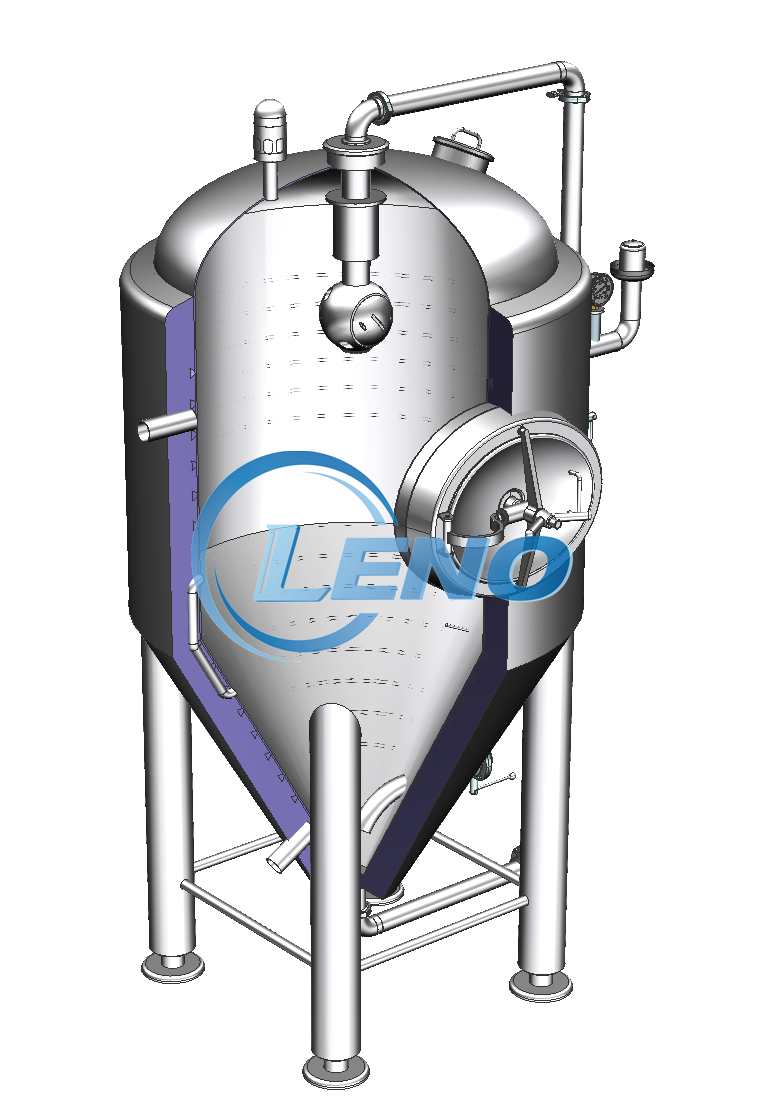
Conical geometry solves these fundamental physics problems seamlessly. A steep cone funnels trub and dormant yeast downward toward a central point. Most commercial models utilize a 60-degree angle. This specific shape compresses the sediment into a highly compact area near the bottom butterfly valve. It dramatically minimizes the physical contact area between the resting liquid and the yeast cake. You can simply open the bottom valve to remove unwanted solids. You achieve this targeted removal without ever transferring the liquid to another vessel.
Feature | Flat-Bottom Fermenters | Conical Fermenters |
|---|---|---|
Yeast/Trub Contact Area | High (entire base diameter) | Low (compacted in the cone apex) |
Secondary Transfers | Required to prevent autolysis | Eliminated (single-vessel process) |
Oxygen Exposure Risk | High (due to racking) | Minimal (closed-system dumping) |
Cleaning Method | Manual scrubbing required | CIP (Clean-In-Place) compatible |
Zero-loss trub removal transforms your brewhouse efficiency. You no longer leave highly profitable beer behind during messy racking transfers. The dumping procedure is straightforward and highly repeatable. Proper execution yields higher volumes of clarified beer per batch. Follow these exact steps for optimal solid removal:
Wait for primary fermentation to reach terminal gravity.
Activate the glycol system to crash cool the vessel.
Allow 24 to 48 hours for the yeast and cold break to compact.
Slowly open the bottom butterfly valve over a collection bucket.
Allow the thick, toothpaste-like slurry to push out.
Close the valve immediately when clear beer begins to flow.
Yeast harvesting and repitching offer massive commercial savings. You harvest vital, healthy yeast directly from the cone. You pitch this active slurry right into your next batch. This practice turns a single laboratory yeast purchase into multiple generations of use. Commercial operations save thousands of dollars annually on raw materials alone. You actually improve yeast health and vitality through consistent repitching. The yeast adapts to your specific brewhouse environment over successive generations. You build a proprietary house strain naturally.
Labor and sanitation savings represent another massive operational upgrade. Modern equipment enables true Clean-In-Place (CIP) operations. You simply attach a dedicated pump to the integrated spray balls. Caustic and sanitizer solutions circulate automatically under high pressure. You eliminate dangerous manual scrubbing entirely. You also skip tedious secondary racking steps. Brewers save distinct manual labor hours during every single production cycle. They can redirect this valuable time toward recipe development, packaging, or facility maintenance.
Closed-loop transfers protect your final product completely. A conical fermenter facilitates fully pressurized transfers. You push the finished beer to kegs or brite tanks using CO2 or nitrogen. This process creates an oxygen-free environment from start to finish. You eliminate post-fermentation oxidation risks entirely. Your hazy IPAs and delicate lagers retain their fresh flavor profiles much longer. The shelf life of your packaged product extends significantly. You also prevent volatile aroma compounds from scrubbing out into the atmosphere.
Advanced dry hopping becomes significantly easier and more effective. You can drop the dormant yeast out of the bottom valve first. You do this before adding any dry hop pellets. This specific sequencing prevents sticky hop matter from coating the yeast cells. You unlock several distinct brewing advantages:
Reduced Hop-Bite: You avoid extracting harsh, astringent polyphenols from extended hop contact.
Mitigated Hop-Creep: Removing yeast limits the enzymatic breakdown of complex sugars introduced by dry hops.
Better Oil Extraction: Hops interact directly with the beer rather than sticking to yeast sediment.
Easy Sludge Removal: You easily dump the heavy hop slurry out of the same bottom port afterward.
Unitank functionality offers the ultimate operational flexibility. Many premium vessels are specifically rated for internal pressure. You can ferment, crash, carbonate, and package from one single location. You trap natural fermentation CO2 by capping the blow-off tube near the end of primary fermentation. You carbonate the liquid quickly using an integrated carb stone. This removes the need for dedicated brite tanks. You reduce your total equipment footprint. You also minimize the time your beer spends moving through brewery hoses.
Material integrity dictates equipment lifespan and safety. You must understand the difference between standard 304 and medical-grade 316L stainless steel. Standard 304 works perfectly for most standard brewing applications. However, 316L offers superior resistance to chlorides and harsh acidic environments. Cheaper plastics or thin-gauge metals warp over time. They fail under pressure or degrade during hot caustic CIP cycles. A high-quality stainless steel fermenter withstands daily commercial abuse without compromising structural integrity.
Component | Budget/Cheap Option | Commercial-Grade Option |
|---|---|---|
Material | Plastic / Thin 201 Stainless | Heavy-gauge 304 or 316L Stainless |
Welds | Rough joints, potential crevices | Sanitary TIG welded, ground smooth |
Fittings | Threaded bulkheads (NPT) | Sanitary Tri-Clamp (TC) |
Cooling | Internal drop-in coils | Dual-zone exterior glycol jackets |
Welds and sanitation risks separate professional gear from cheap alternatives. You need perfectly smooth, sanitary TIG welds inside the vessel. Cheaper tanks often feature rough joints or microscopic crevices. These tiny gaps harbor aggressive spoilage bacteria. They resist chemical sanitation. A single bacterial infection ruins an expensive batch. Paying for premium welding prevents catastrophic product loss. You should physically inspect the interior welds with a flashlight before commissioning any new equipment.
Fittings and modularity determine long-term usability. We strongly advocate for industry-standard Tri-Clamp (TC) fittings. You should avoid threaded bulkheads entirely. Threads trap microscopic organic matter. They require meticulous manual scrubbing with specialized brushes. TC fittings guarantee perfectly sanitary connections. You can easily attach sample valves, thermowells, and blow-off tubes. They break down in seconds for visual inspection. You can swap parts globally because TC sizing is standardized across the food and beverage industry.
Cooling architecture controls your fermentation profile. Cheap vessels often rely on simple internal cooling coils. These coils sit directly inside the liquid. They are incredibly difficult to clean. They also offer lower cooling efficiency. Commercial vessels utilize dual-zone glycol jackets instead. The cooling medium circulates through channels welded to the exterior shell. You control the cone and the side walls independently. This provides precise temperature control. It carries absolutely zero contamination risk.
Space and clearance constraints require careful facility planning. Conical designs are significantly taller than equivalent-volume flat tanks. The 60-degree cone adds substantial vertical height to the unit. You must measure ceiling clearance before purchasing anything. You need overhead room to access top manways safely. You also need clearance for adding dry hops. Check your doorway widths carefully for rigging the equipment inside. Map out your glycol piping routes in advance to avoid complicated overhead plumbing nightmares.
Chiller sizing is a common trap for scaling breweries. A jacketed brewery tank requires an adequately sized glycol chiller. Many operators upgrade their vessel volume without checking their cooling capacity. A small chiller cannot handle the massive crash-cooling load of a large batch. Verify your existing chiller’s BTU output first. It must actively drop the liquid temperature from fermentation temps to near-freezing within 24 hours. Undersized chillers burn out compressors prematurely.
Batch sizing realities dictate your daily operations. You must understand the minimum and maximum fill volumes. Buying equipment that is too large for your brewhouse output causes severe problems. Small batches in massive vessels create excessive headspace. This dilutes the natural CO2 blanket. It leads to inefficient fermentation and potential oxidation. Match your vessel capacity strictly to your actual cast-out volume. Standard practice recommends leaving roughly 20% headspace for active krausen during primary fermentation.
Upgrading your primary fermentation equipment is a foundational step for commercial viability. The transition is less about aesthetic appeal and more about mitigating operational risk. Conical vessels improve product consistency while accelerating production cycles dramatically. By moving away from flat-bottom tanks, you eliminate oxidation threats and reclaim lost manual labor hours.
Prioritize Sanitary Design: Focus on smooth TIG welds, CIP readiness, and Tri-Clamp modularity over raw holding capacity when balancing a tight budget.
Leverage Unitank Capabilities: Utilize pressurized vessels to carbonate and package directly, reducing the need for secondary brite tanks.
Calculate Your ROI: Evaluate your current monthly yeast expenditure and manual cleaning labor hours. Use these metrics to determine your precise payback timeline before requesting manufacturer quotes.
A: For commercial consistency and cold crashing, yes. Ambient cooling is too slow and imprecise for high-yield operations. Glycol jackets allow you to control exothermic fermentation temperatures accurately and crash the beer to compact the yeast cake efficiently.
A: 60 degrees is the industry standard for optimal yeast flocculation without making the tank impractically tall. This angle ensures sediment slides down to the bottom valve smoothly without clinging to the sidewalls.
A: Only if the tank is specifically rated as a unitank with a tested safe working pressure, typically 15 PSI or higher, and equipped with a carbonation stone. Non-pressurizable vessels will rupture under carbonation pressures.
A: Depends on scale, but between yeast repitching savings and recovered labor hours, ROI is typically achieved within 12 to 18 months of active production. Reduced batch loss from contamination further accelerates this timeline.


