Language

Views: 0 Author: Site Editor Publish Time: 2026-09-04 Origin: Site


Pharmaceutical manufacturing operates under the highest possible stakes every single day. A single equipment failure or microscopic contamination event easily leads to catastrophic batch loss. Such incidents trigger severe regulatory action and compromise patient safety on a global scale. Selecting the right production equipment is never a simple commodity purchase. You must treat it as a critical, long-term risk-management decision. Every internal surface, weld joint, and port introduces potential vulnerabilities if they are poorly engineered.
This comprehensive guide provides an objective framework for evaluating a Sanitary Stainless Steel Tank accurately. We focus heavily on the core engineering features driving complete cleanability, strict regulatory compliance, and operational reliability. You will learn exactly how to assess material grades, hygienic design standards, and essential validation documentation. We aim to equip your team with the knowledge required to safeguard your next critical processing line.
Material matters most: 316L stainless steel with proper electropolishing is the non-negotiable baseline for active pharmaceutical ingredient (API) and sterile processing.
Sanitary design prevents biofilms: Zero dead-legs, proper weld geometries, and integrated CIP/SIP capabilities are critical for verifiable sterilization.
Documentation equals compliance: A tank without comprehensive Material Test Reports (MTRs) and FAT/SAT documentation is a regulatory liability.
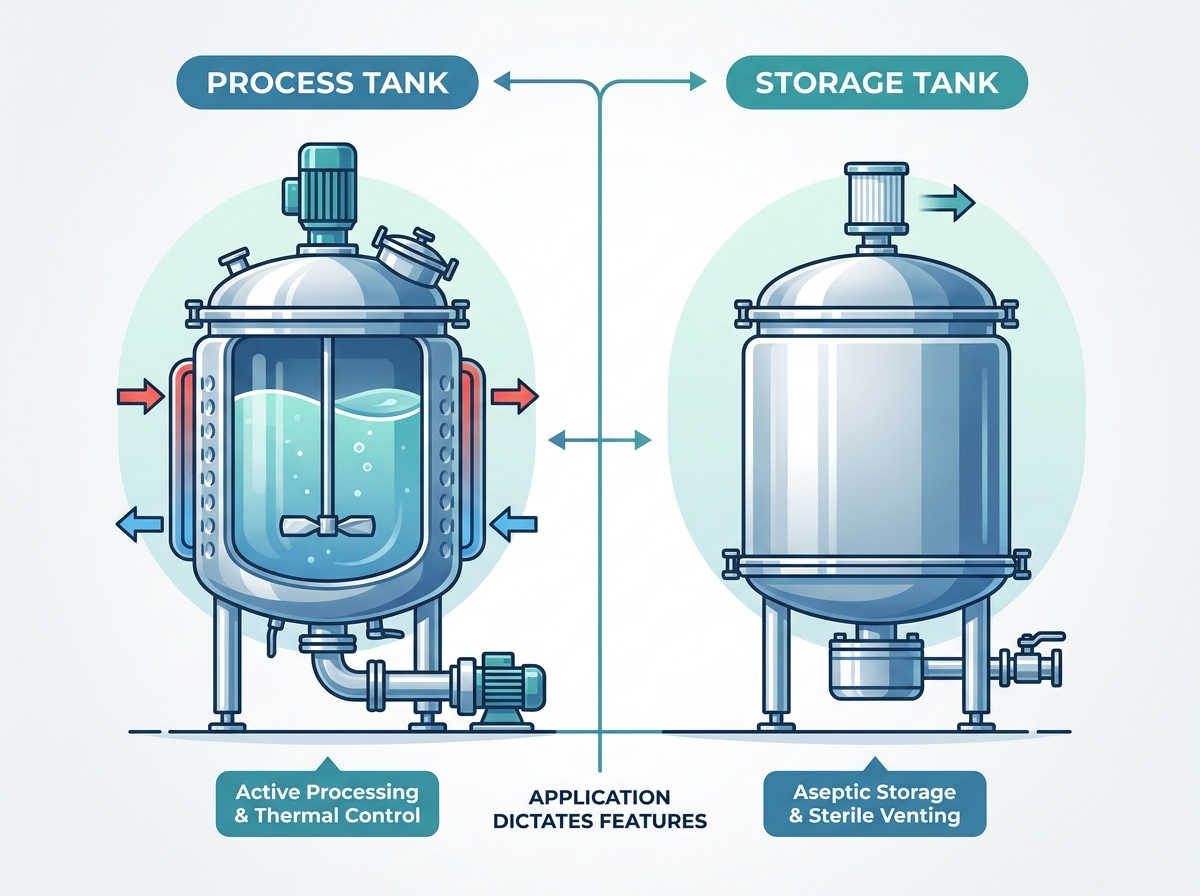
Application dictates features: Process tanks require precise thermal jackets and aseptic agitation, whereas storage tanks prioritize volume stability and sterile venting.
The pharmaceutical industry relies heavily on 316L stainless steel. It serves as the undisputed baseline for active pharmaceutical ingredients (API) and sterile processing. This specific grade contains additional molybdenum. Molybdenum provides superior resistance against aggressive chlorides. It easily withstands harsh Clean-in-Place (CIP) chemicals. You cannot compromise on this alloy for critical process vessels.
Sometimes, 304L remains an acceptable alternative. You might deploy it for non-critical buffer storage. Utility water systems also utilize 304L frequently. This choice helps teams transparently manage budget expectations. It achieves cost reductions without risking strict compliance standards in non-sterile zones.
Internal surface finishes require strict evaluation protocols. Regulatory bodies typically expect an internal Ra value under 0.4 µm (15 micro-inches). Manufacturers achieve this extreme smoothness through precise electropolishing procedures.
Electropolishing electrochemically strips away microscopic peaks and valleys. It leaves a highly passive, uniform layer behind. Smooth surfaces minimize biofilm adherence drastically. They also reduce overall CIP cycle times. A properly polished Stainless Steel Tank guarantees faster turnaround between manufacturing batches.
High-purity water systems often face a phenomenon called "rouging." This chemical reaction creates red iron oxide deposits on interior surfaces. Proper initial surface treatment and routine passivation mitigate this risk. You must monitor wetted surfaces continually to prevent rouge buildup.
Sanitary design strictly prevents fluid stagnation. Engineers follow the L/D (Length to Diameter) ratio rule constantly. This rule dictates the geometry of all sanitary piping and instrument ports. An L/D ratio of 2:1 or less is the industry standard. It ensures CIP fluids reliably reach all internal boundaries. Zero dead-legs mean zero places for dangerous bacteria to hide.
Welds demand evidence-oriented fabrication standards. Manual welding often introduces microscopic human errors. You need automated orbital welding for pharmaceutical applications. This automated process ensures full penetration across all structural joints. It regulates heat input precisely to prevent metallurgical discoloration.
Manufacturers must then flush-polish these welds perfectly. Flush joints prevent microbial harborage completely. Poorly finished welds ruin otherwise exceptional engineering designs.
Automated cleaning systems require precise vessel integration. Spray ball configurations depend entirely on internal tank geometry. Static spray balls work adequately for smaller vessels. Dynamic or rotary sprayers handle larger, more complex internal geometries. They provide high-impact cleaning across wide interior spans.
Vessels undergo Sterilization-In-Place (SIP) procedures regularly. SIP introduces extreme temperature and pressure fluctuations rapidly. Tanks need robust pressure and vacuum ratings to survive these thermal shocks. Without appropriate ratings, structural collapse becomes a serious operational risk.
Active processing requires highly efficient thermal control. Dimple jackets offer excellent heating and cooling transfer rates. They work well for managing most pharmaceutical liquids. Half-pipe coil jackets handle high-pressure thermal media much better.
Insulation cladding protects these internal heating jackets. Builders typically use fully welded 304 stainless steel sheathing. This outer skin prevents external moisture ingress. It stops potential cross-contamination in strictly regulated cleanroom environments.
Mixing requirements dictate your specific agitation technology. Top-entry mechanical mixers deliver incredibly high shear forces. However, they require complex sanitary mechanical seals. These intricate seals demand rigorous maintenance protocols to prevent leaks.
Bottom-mount magnetic mixers offer a much safer alternative. They feature zero shaft penetration through the vessel wall. This hermetic design makes them ideal for strict aseptic environments. Sanitary baffles help optimize this magnetic mixing process. They improve fluid dynamics significantly without compromising overall cleanability.
Storage vessels prioritize long-term volume stability. Rapid fluid drawdown creates sudden internal vacuum conditions. Sanitary burst discs provide vital emergency pressure relief. Sterile vent filters (typically 0.22-micron) allow safe, filtered air displacement. They maintain strict aseptic conditions during routine fluid transfer operations.
Application Type | Primary Function | Agitation Style | Critical Hardware |
|---|---|---|---|
Process Vessel | Active compounding and thermal cycling | Top-entry mechanical or bottom magnetic | Dimple jackets, sanitary baffles |
Storage Vessel | Long-term hold and volume stabilization | Minimal or low-shear magnetic | 0.22-micron vent filters, burst discs |
Hygienic design must align strictly with ASME Bioprocessing Equipment (BPE) standards. These rigid guidelines dictate precise hygienic fabrication methods. They require specific corner radii and self-draining vessel floors. Operational safety falls directly under current Good Manufacturing Practice (cGMP) guidelines. Compliance is never optional; it remains a legal mandate.
A vessel represents a massive regulatory liability without proper documentation. The Turnover Package (TOP) serves as your primary audit trail. You must secure these non-negotiable documents before accepting delivery:
Material Test Reports (MTRs) for all wetted metal components.
Detailed weld logs mapping every single structural joint.
Welder certifications proving specialized technical competency.
Surface finish certificates verifying acceptable Ra values.
Comprehensive pressure and hydrostatic test reports.
You should immediately disqualify vendors who hesitate here. A pre-structured, thorough TOP proves a vendor understands complex pharmaceutical requirements.
Validation frameworks mitigate severe financial and regulatory risks. Factory Acceptance Testing (FAT) catches critical defects before shipping occurs. Site Acceptance Testing (SAT) proves hardware functionality post-installation. These validation steps must occur before final capital handover. You must never skip or rush these critical validation phases.
Evaluating fabrication partners requires looking closely at their historical track record. Look for successful implementations in highly regulated global markets. FDA and EMA environments demand specific, verifiable fabrication expertise.
You must also evaluate their internal engineering support capabilities. Consider these critical technical questions during vendor vetting:
Do they offer custom computational fluid dynamics (CFD) modeling?
Can they accurately model fluid mixing behaviors before steel fabrication begins?
Do they prove internal CIP coverage through advanced software simulation?
Do they maintain in-house orbital welding and electropolishing facilities?
Initiating a vendor Request for Quote (RFQ) takes careful preparation. You need a highly detailed User Requirement Specification (URS). A vague URS leads directly to substandard equipment delivery.
Include clear operational definitions in your RFQ process. Define exact working volumes and minimum product viscosity. Specify all heating, cooling, and insulation needs clearly. Demand explicit ASME BPE compliance markers throughout the build. Finally, request a detailed outline of their standard TOP structure upfront.
Evaluating bioprocessing equipment goes far beyond checking volume and dimensional constraints. It serves as a rigorous exercise in microbiological control. Properly engineered equipment forms your primary regulatory defense mechanism. Cutting corners on material finishes or weld quality always results in downstream operational failures.
Encourage strict cross-functional alignment immediately. Engineering, quality assurance, and procurement teams must collaborate openly. They should review all technical details before finalizing equipment specifications. This collaborative approach prevents expensive post-installation modifications.
Review your current User Requirement Specifications (URS) today. Compare your documents directly against the compliance markers detailed above. Protect your manufacturing processes by demanding pure engineering excellence from your chosen vendor.
A: Standard industrial tanks prioritize general liquid holding capacity. A Sanitary Stainless Steel Tank focuses exclusively on verifiable cleanability. It requires specific Ra surface finishes and hygienic port designs, like Tri-Clamp connections. These vessels strictly adhere to ASME BPE standards to eliminate any microscopic microbial harborage points.
A: Pharmaceutical processes utilize highly acidic or alkaline CIP chemicals constantly. They often involve aggressive, chloride-rich environments. 316L stainless steel contains added molybdenum. This critical element prevents pitting and corrosion effectively. It provides a much more robust defense than 304, ensuring long-term structural integrity and absolute product purity.
A: You should expect a comprehensive Turnover Package (TOP). This critical audit trail includes Material Test Reports (MTRs) for all metals. It also contains detailed orbital weld logs, surface finish (Ra) certificates, professional welder qualifications, and complete FAT/SAT validation testing protocols.
A: Magnetic mixers excel in low-viscosity, aseptic blending applications. They work perfectly for buffer preparation or liquid vaccines. However, they possess distinct mechanical limitations. They typically lack the immense shear force required for high-viscosity ointments, thick gels, or dense suspensions. Heavy products generally require top-entry mechanical agitation.


