Language

Views: 0 Author: Site Editor Publish Time: 2026-09-03 Origin: Site


Selecting industrial tankage is not a simple commoditized purchase. Facilities face serious operational risks when they rush this critical engineering decision. You might choose the wrong geometry, an inadequate material grade, or a mismatched agitation setup. These specific errors routinely lead to severe product loss, failed compliance audits, and crippling operational downtime. We built this comprehensive guide to help process engineers and procurement teams navigate these hidden complexities.
You will discover a strict, evidence-based framework for evaluating, specifying, and sourcing your processing equipment. We prioritize hard evaluation criteria over flashy marketing claims. By focusing strictly on fluid dynamics, material science, and regulatory compliance, you can secure long-term operational success. Whether you need standard holding vessels or complex customized geometries, this approach ensures you get exactly what your facility requires. Learn how to analyze your specific chemistry and structural constraints before you finalize your specifications and issue a purchase order.
Process requirements—specifically viscosity, temperature control, and specific gravity—must dictate the structural design and material grade of your tank.
304 and 316L stainless steel are not interchangeable; chloride presence and sanitation standards demand specific alloy selections.
A well-configured stainless steel mixing tank requires precise calculations for working volume, baffle placement, and agitator torque to prevent dead spots.
Procurement evaluation should heavily weight Factory Acceptance Testing (FAT), weld documentation, and Total Cost of Ownership (TCO) over upfront capital expenditure.
Before you evaluate a Stainless Steel Tank, you must establish a rigid application baseline. We always differentiate between static holding and dynamic processing. Static holding involves simple buffer tanks and bulk liquid storage. These vessels sit quietly. They do not require robust structural reinforcement for mechanical torque. Dynamic processing is entirely different. It requires active blending, solid particle suspension, or rapid heat transfer. These active applications demand thicker walls and highly engineered support structures.
Next, you must map out the specific fluid characteristics of your process. We call this defining the chemistry. You need to record the specific gravity, viscosity in centipoise, and pH levels. Highly viscous products demand radically different tank geometries compared to simple aqueous solutions. For example, a heavy resin requires specialized high-torque impellers to ensure proper flow. Shear-sensitive products, like lotions or dairy creams, require gentle agitation to prevent product degradation. You cannot use a one-size-fits-all approach here.
Finally, you must apply the appropriate regulatory and compliance lenses. Identify the minimum hygienic and structural standards your specific industry mandates. Pressurized vessels almost always require formal ASME certification. Petrochemical facilities follow strict API design guidelines. Food, beverage, and pharmaceutical plants depend heavily on 3-A Sanitary Standards or FDA regulations. Identifying these essential standards early prevents catastrophic compliance failures during your facility audits.
Process engineers frequently debate which material grade suits their application best. We must look closely at the two dominant alloys in the industry. They behave very differently under stress.
Industry professionals widely consider 304 stainless steel the standard baseline choice. It works exceptionally well for neutral liquids, dry powder storage, and non-corrosive environments. You get excellent structural durability without over-engineering your setup. Standard applications benefit greatly from its balanced performance profile. It handles typical ambient moisture and basic cleaning chemicals without degrading.
Conversely, 316L stainless steel features a crucial addition of molybdenum. It also has a lower carbon content, which the "L" signifies. You must specify 316L for high-chloride environments and aggressive chemical exposures. Stringent pharmaceutical applications also mandate it. Pitting resistance remains absolutely non-negotiable in these high-purity sectors. The extra molybdenum prevents salt and chlorides from eating microscopic holes into the vessel walls.
Surface finish acts as a critical functional requirement, not merely a cosmetic enhancement. Standard mill finishes, like 2B, work well for basic industrial applications. However, sanitary environments require mechanical polishing, such as a #4 finish. Many high-purity processes go further and demand comprehensive electropolishing. These ultra-smooth surfaces ensure optimal Clean-In-Place (CIP) performance. They eliminate the microscopic metallic crevices where dangerous bacteria typically hide.
Table 1: Alloy Comparison and Application Suitability
Material Grade | Key Alloy Addition | Corrosion Resistance | Primary Industry Applications |
|---|---|---|---|
304 Stainless Steel | Standard Chromium/Nickel | Moderate (Neutral environments) | Dry bulk, breweries, basic chemicals |
316L Stainless Steel | Molybdenum (2-3%) | High (Chloride/Salt environments) | Pharmaceuticals, cosmetics, harsh chemicals |
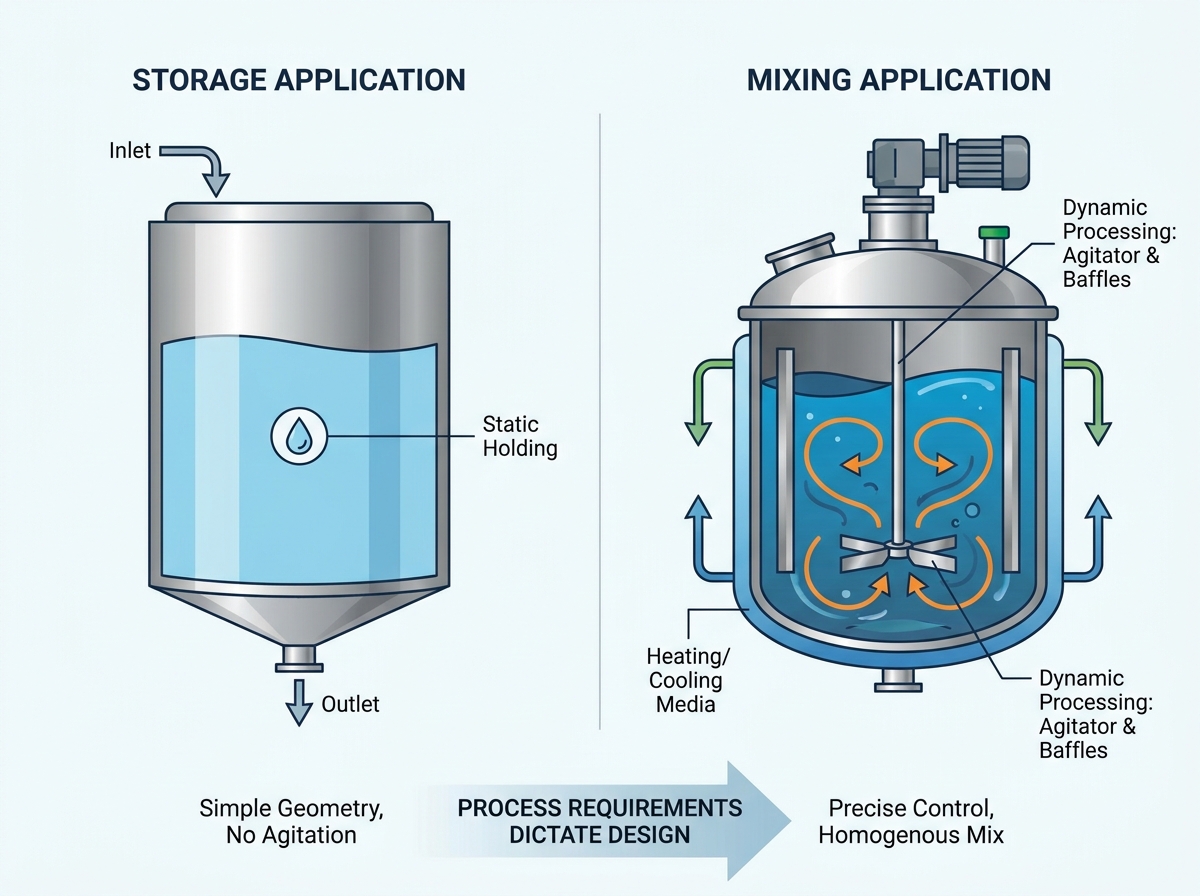
When you configure a specialized Stainless Steel Tank,Stainless Steel Mixing Tank assembly, volume calculations require absolute precision. We differentiate clearly between nominal capacity and working capacity. Nominal refers to the total geometric volume of the empty vessel. Working capacity is the actual liquid volume you process during a batch. You must leave 10–20% freeboard, or empty headspace, at the top. This extra room safely accommodates thermal expansion and aggressive vortexing during active agitation.
Agitation and baffling dictate your overall mixing efficiency. You must evaluate criteria for top-entry, bottom-entry, or side-entry agitators based on fluid viscosity. Top-entry units handle general blending well. Bottom-entry magnetic mixers excel in highly sanitary pharmaceutical applications. Baffles play a critical supporting role here. These internal metal plates prevent the fluid from endlessly swirling. They promote axial and radial flow patterns instead. This calculated flow guarantees homogenous blending and prevents dead spots.
Thermal control options vary significantly based on your process demands. Single-wall construction works perfectly for ambient temperature storage. Alternatively, jacketed configurations offer precise thermal regulation for sensitive batch processes. Dimple jackets handle steam or chilled water efficiently across large surface areas. Half-pipe coils work best for high-flow thermal fluids and high-pressure heating cycles. They provide superior structural integrity under thermal stress.
You also need to carefully evaluate access and containment features. Open-lid designs allow easier manual access and quick cleaning for non-volatile liquids. Conversely, sealed manways remain essential for pressurized, volatile, or highly sanitary environments. A fully sealed manhole prevents external contamination. It also protects your floor operators from inhaling hazardous chemical fumes during the mixing cycle.
Equipment buyers face a critical choice between standard geometries and custom engineering. You should leverage off-the-shelf designs whenever possible. They offer much faster lead times and rely on proven structural engineering. Standard models eliminate the guesswork from fluid dynamics. However, custom engineering becomes completely necessary when you face specific facility footprint constraints. You might also need highly tailored nozzle placements to perfectly match your existing facility piping infrastructure.
Many procurement teams consider the secondary equipment market. The reality of used tanks involves significant hidden risks. You must execute a rigorous engineering inspection checklist before acquiring used vessels. Always verify the remaining material thickness using ultrasonic testing to detect abrasive wear. You must inspect weld integrity for microscopic fissures that harbor dangerous bacteria. Furthermore, you must aggressively assess the interior for hidden corrosion or dangerous chemical contamination residuals.
Vendor trust and strict quality control ultimately dictate your long-term success. You must demand comprehensive documentation from your chosen manufacturer. Documented weld maps prove fabrication quality and worker traceability. Material test reports (MTRs) verify the exact alloy composition of the steel sheets. Above all, you must require a comprehensive Factory Acceptance Testing (FAT) protocol. This testing ensures the vessel performs perfectly before it ever ships to your processing facility.
Procurement logic extends far beyond the initial equipment specifications. You must factor in exactly how the vessel integrates into your daily facility operations. Evaluate mechanical compatibility with your automated CIP/SIP (Clean-In-Place / Sterilize-In-Place) systems. Determine the routine maintenance intervals for mechanical seals and bottom valves. You should also review the energy draw of the mixing motors. They must align perfectly with your facility's existing electrical infrastructure and breaker limits.
Facility integration constraints often derail implementation schedules. Buyers routinely overlook basic logistical installation hurdles. You must verify ceiling height clearance for tall top-mounted agitators. Measure all door widths, elevator dimensions, and hallway turns for the installation path. Furthermore, you must confirm your concrete floor load-bearing capacities. A fully loaded mixing vessel exerts immense concentrated pressure on concrete foundations.
We recommend a concrete shortlisting framework to streamline your final procurement process. Following a structured approach prevents critical omissions.
Finalize your detailed fluid specification sheet, including viscosity and specific gravity.
Confirm all dimensional constraints within your physical processing room.
Request detailed engineering submittals and CAD drawings from the vendor.
Verify all compliance certifications and material test reports before issuing a Purchase Order.
Executing these steps methodically ensures a seamless physical installation. It also guarantees reliable operation from the very first production batch.
Choosing the right industrial equipment requires a strict balance of process chemistry, structural physics, and facility constraints. You cannot afford to guess when specifying these critical production vessels. An improperly sized agitator or a mismatched material grade will severely disrupt your entire manufacturing line. We strongly encourage buyers to move completely away from poorly researched decisions. Instead, pivot toward performance-driven specifications that guarantee strict operational uptime and safety.
Carefully evaluate your specific fluid dynamics, material grade requirements, and agitation needs. Take decisive action today to secure and optimize your processing line. We highly recommend mapping out your facility constraints before contacting vendors. Reach out to an experienced engineering team directly. They can review your specific process data, run fluid dynamic calculations, and recommend a highly optimized solution for your unique industrial application.
A: Converting a standard storage vessel is highly discouraged. Storage designs lack the necessary structural reinforcement to handle dynamic mechanical torque. You will face severe mounting issues when adding heavy overhead agitators. Additionally, they lack internal baffles, which leads to inefficient fluid swirling rather than proper homogenous mixing. It is safer to specify a dedicated mixing vessel from the start.
A: You need a jacketed vessel if your process requires strict temperature regulation. Look closely at your temperature thresholds. If your fluid undergoes exothermic reactions during blending, a cooling jacket is absolutely mandatory. Jacketing is also essential if you must heat highly viscous products to maintain fluid flow and ensure proper downstream pumping.
A: Typical lead times range from 12 to 24 weeks. This timeline fluctuates based on several specific factors. Engineering approvals and design revisions take significant time upfront. Material availability for specialized alloys like 316L also impacts the fabrication schedule. Complex jacketed designs or specialized high-shear agitator requirements will extend your final delivery dates further.
A: A properly engineered industrial vessel easily lasts 20 to 30 years or more. You must correctly specify the material grade for your specific fluid chemistry. Routine maintenance, such as checking mechanical seals and passivating the metal, greatly extends its lifespan. Operating strictly within the designed pressure and temperature limits prevents premature structural fatigue and failure.


