Language

Views: 0 Author: Site Editor Publish Time: 2026-09-06 Origin: Site


Transitioning or upgrading to a commercial-grade processing vessel represents a critical risk-management decision. It directly optimizes yield for food and beverage operations. Batch contamination brings escalating financial penalties. It also causes severe brand damage. Strict FDA and USDA regulatory scrutiny leaves absolutely no room for error. Legacy or non-sanitary storage solutions simply cannot meet today's rigorous hygiene demands. Operations using outdated equipment face constant compliance threats.
This guide provides a comprehensive technical and operational framework. You will learn how to evaluate, specify, and integrate these essential vessels. We cover critical material selection, advanced thermal control, and strict hygiene compliance. Understanding these engineering principles ensures your facility achieves peak operational efficiency. You will discover how to eliminate microbial risks while protecting your valuable product batches.
Material Selection Dictates Lifespan: Choosing between 304 and 316L stainless steel depends strictly on the chemical profile (e.g., chloride content, acidity) of the processed food or beverage.
Hygiene Relies on Surface Engineering: Proper sanitary design requires specific internal surface finishes (Ra values) and specialized welding (TIG) to prevent microbial harboring.
Thermal Control Defines Batch Consistency: Integrated dimple jackets and agitation systems are non-negotiable for temperature-sensitive processes like fermentation and pasteurization.
Compliance is Verifiable: Legitimate vendor evaluation requires demanding documentation, including Material Test Reports (MTRs) and 3-A Sanitary Standard certifications.
Inadequate vessels hide massive operational costs. Extended cleaning downtime strips productive hours from your weekly schedule. Every hour spent scrubbing a substandard tank reduces your overall yield. Product spoilage destroys profitability rapidly. It wastes expensive raw ingredients. Inconsistent batch scaling frustrates customers and ruins brand reputation. Operators struggle to maintain strict quality standards when their equipment limits their control.
Your new vessel must solve these specific production challenges. Facility managers should evaluate equipment upgrades against three demanding operational metrics. Meeting these criteria guarantees a robust return on your capital investment.
Contamination Elimination: Biofilms cling to microscopic scratches. Non-porous surfaces repel bacteria entirely. They secure product integrity across every batch. Proper alloys prevent organic matter from bonding to the vessel walls.
CIP/SIP Efficiency: Aggressive chemicals clean the vessel interior rapidly. Extreme heat sterilizes the mechanical system. High-grade alloys survive these harsh Clean-in-Place and Sterilize-in-Place cycles seamlessly. Lesser metals degrade quickly under thermal stress.
Flavor Neutrality: Plastics absorb pungent odors easily. They leach unwanted chemical compounds into subsequent batches. A high-quality Food Grade Stainless Steel Tank guarantees absolute flavor purity. It never alters your strict flavor profiles.
Best Practice: Audit your current CIP cycle times meticulously. If cleaning operations take longer than actual processing, you need an immediate equipment upgrade.
Common Mistake: Ignoring microscopic surface degradation over time. Tiny surface scratches act as perfect breeding grounds for dangerous pathogens.
Use cases include heavy syrups, complex sauces, and liquid dairy processing. Different liquid viscosities demand unique mechanical solutions. Thick materials resist basic stirring.
Key features rely on specialized mechanical agitation. High-shear mixers emulsify thick ingredients perfectly. They prevent phase separation in salad dressings. Scrape surface agitators prevent viscous liquids from burning against heated walls. Teflon blades constantly clear the heated boundary layer. Baffle designs break up internal fluid vortexes. This prevents unwanted air incorporation. Load cell integration guarantees precise ingredient dosing. Operators know exactly how much raw product enters the vessel.
Agitator Selection and Viscosity Summary
Agitator Type | Ideal Viscosity Level | Primary Application |
|---|---|---|
Marine Propeller | Low (Water, Milk, Juice) | Basic liquid blending and light suspension. |
High-Shear Rotor | Medium to High | Emulsifying sauces, dressings, and thick syrups. |
Scrape Surface | Very High | Heating viscous purees without causing burn-on. |
Brewing, winemaking, and cultured dairy rely on strict biological environments. Yeast requires precise environmental conditions to perform correctly.
Conical bottoms allow efficient yeast and trub harvesting. Operators remove solid sediment without transferring the liquid batch. ASME pressure-rated construction safely contains natural carbonation. Strong steel handles the internal force easily. Sanitary sample valves let you test flavor profiles safely. They prevent external ambient contaminants from entering the active batch.
Buffer storage smooths out unpredictable production workflows. It bridges the timing gap between fast processing lines and slower packaging machines.
Aseptic blanketing capabilities push out harmful oxygen. A constant nitrogen purge preserves product freshness for weeks. Advanced level sensors automate line flow seamlessly. Heavy-duty polyurethane insulation maintains ambient or chilled states. It drastically reduces daily utility expenses.
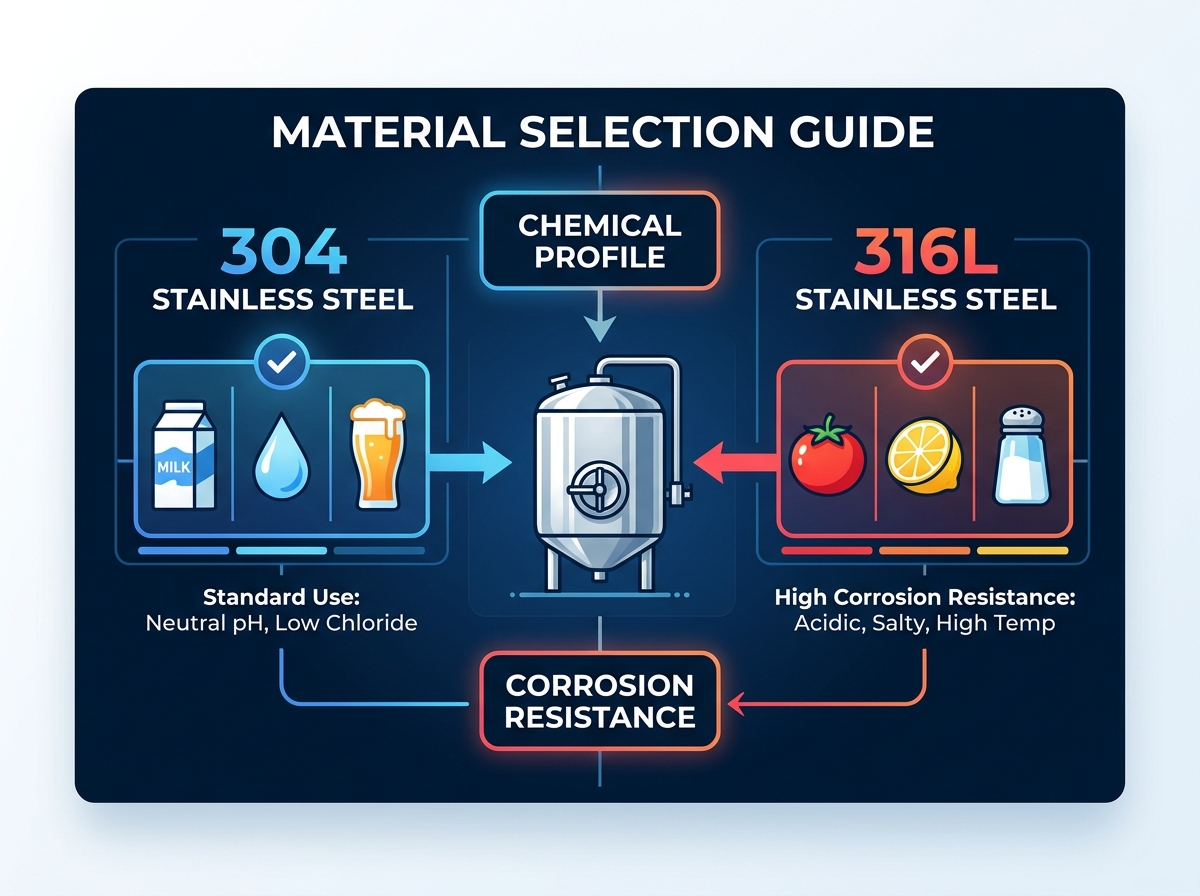
Material selection determines your vessel longevity. You must assess the product acidity and salt content carefully before purchasing.
Rule of Thumb: Specify 304 alloy for neutral liquids. Milk, water, and beer thrive in 304 environments. Mandate 316L alloy for aggressive liquids. High-chloride, highly acidic, or high-salinity products demand better protection. Tomato sauce, harsh brines, and citrus juices cause immediate pitting corrosion in weaker metals. The added molybdenum in 316L provides exceptional chemical resistance. It acts as an invisible armor against salt degradation.
Alloy Properties Comparison
Alloy Grade | Corrosion Resistance | Best Used For | Cost Profile |
|---|---|---|---|
304 | Standard | Neutral liquids, dairy, brewing, water. | More economical. |
316L | Exceptional (Chloride resistant) | High acid, brines, tomatoes, citrus. | Higher initial investment. |
A processing vessel is only as sanitary as its microscopic surface. Microbes exploit the smallest physical imperfections. A profilometer measures these tiny valleys.
Demand an internal finish of 32 Ra or smoother. This serves as the standard F&B compliance requirement. Dairy applications often require even smoother finishes around 15 Ra. Following mechanical polishing, operators must apply chemical passivation. Nitric or citric acid treatments strip away free iron from the surface. This process restores the crucial protective chromium oxide layer. The metal literally heals its own micro-abrasions.
Heating and cooling require massive facility energy. Efficient thermal management reduces your overhead costs significantly.
Evaluate dimple jackets against channel jackets. Dimple jackets spot-weld directly to the vessel exterior. They create turbulent flow for coolants like glycol or ammonia. This turbulence maximizes heat transfer efficiency. Channel jackets handle higher flow rates and heavier pressures. Choose the design based on your existing facility utility capacities.
Best Practice: Always insulate a jacketed vessel entirely. Uninsulated heating jackets radiate expensive thermal energy right into your production room.
Common Mistake: Pumping highly pressurized chilled glycol into a vessel rated only for low-pressure water. This operational mistake fractures the delicate jacket welds instantly.
Micro-crevices in structural welds serve as the primary source of bacterial contamination. Bad welds destroy good product. Quality control depends on exceptional metalwork.
Ensure all interior seams undergo continuous TIG (Tungsten Inert Gas) welding. TIG provides superior control over the weld pool. Fabricators must grind these welds perfectly flush. They polish the seams to remove all porosity and heat tint. This eliminates any harbor points for biofilms. A fully polished interior defines a true Stainless Steel Tank built for rigorous food applications.
Dead legs present a massive compliance risk. A dead leg is a stagnant zone. Fluid stops moving here during the CIP process. Wash chemicals bypass these areas completely. Bacteria multiply freely in these hidden pockets.
Specify sanitary Tri-Clamp connections exclusively. They disassemble quickly for manual inspection. Never use threaded fittings in the product zone. Threads trap organic matter immediately. Adhere strictly to the "L/D ≤ 2" rule for branch port dimensions. The length of the branch must not exceed twice its diameter. This simple geometric rule ensures wash fluid penetrates every corner thoroughly.
Best Practice: Perform regular riboflavin clearance tests. Operators spray a fluorescent dye inside the vessel. They run a standard CIP cycle. A UV light inspection reveals any hidden dead legs.
Common Mistake: Installing excessively long sample valves. These create instant dead legs. They ruin entire production batches silently.
Do not purchase a vessel without measuring your physical plant first. Footprint and rigging realities dictate project success. Moving large metal structures requires careful logistical planning.
Verify ceiling clearances before finalizing geometric dimensions. Check roll-up door dimensions. Calculate your floor load-bearing capacities. Water weighs roughly 8.34 pounds per gallon. A full vessel exerts immense structural pressure. Your concrete floors must support this active weight safely. Tall and narrow vessels save valuable square footage. Short and wide designs accommodate low ceilings.
Assess utility integration early. Evaluate your current boiler steam capacity. Check your chiller system output. Ensure the facility can actually support the added thermal load. Starving a jacketed vessel of coolant ruins batch consistency.
Vendor selection separates successful projects from costly disasters. Demand strict documentation upfront. Protect your capital investment by auditing the manufacturer.
Shortlist only vendors who provide full Material Test Reports (MTRs). These documents prove the precise metallurgical makeup of your steel. Require an ASME U-stamp if the process involves internal pressure. Mandate verified 3-A Sanitary standard compliance for all product-contact surfaces.
Weigh the cost savings of standard geometries against custom engineering. Off-the-shelf vessels ship faster and cost less initially. Custom port placements and bespoke agitators optimize your facility flow perfectly. The long-term ROI often justifies the custom engineering premium.
Actionable next step: Request a detailed 3D CAD model before signing any purchase order. Demand a verifiable lead-time commitment. Review the drawings with your maintenance team. Ensure the design supports easy CIP execution.
A food-grade vessel is never just a passive bucket. It functions as an active, critical component of your production line. Its structural design dictates operator safety, mechanical efficiency, and final product quality. Choosing the correct alloy prevents catastrophic chemical corrosion. Implementing proper sanitary TIG welds eliminates severe biological risks.
Process engineers and facility managers must take immediate action. Schedule a technical consultation with an engineering specialist. Request a custom quote based on your exact product viscosity. Map out your specific thermal requirements and physical facility constraints. Upgrading your equipment protects your brand identity. It secures your operational future in a highly regulated industry.
A: A true food-grade vessel utilizes either 304 or 316L alloys. It features sanitary, continuous TIG welds with zero microscopic crevices. It relies exclusively on Tri-Clamp fittings rather than standard threads. Finally, it strictly adheres to FDA and 3-A surface finish standards, typically polished to at least 32 Ra to prevent microbial growth.
A: A well-maintained vessel easily lasts 20 to 30 years. Achieving this lifespan requires routine chemical passivation. You must follow proper CIP protocols diligently. Correct initial material selection remains absolutely crucial. You must avoid exposing a standard 304 alloy vessel to harsh chloride stressors.
A: While theoretically feasible, retrofitting carries extreme engineering risks. Field welding a jacket warps the internal metal significantly. This heat distortion severely compromises your internal sanitary finishes. Purchasing a purpose-built jacketed unit proves much more cost-effective. It provides reliable, leak-free thermal performance over the long term.
A: Start by calculating your precise batch volume first. Add a mandatory 20 percent extra capacity for required headspace. This accommodates vigorous mechanical agitation and product foaming safely. Finally, map this total volume to your packaging line. Your batch size must integrate seamlessly with downstream packaging speeds to prevent costly bottlenecks.


